Playday, play every day

Yesterday was Playday 2013, a national celebration of play devoted to encouraging and promoting play for children. This year it was focused on play spaces and playing out in the great outdoors. How many of you played outside yesterday? Did it depend on the weather – too hot, too cold, too sunny, too rainy? Did it depend on whether you had ‘somewhere to go’ to play? Do you have an outdoor playspace near you?

Children today are often limited to sanitised parks and playgrounds, gardens with lawns and patios, discouraged from grubbing around in the dirt or rolling around on grass, climbing trees or picking flowers. Sometimes nannies (and childminder and parents too!) need to think outside the box a little, and make the most of the flexibility home based care affords.

You can find outdoor play spaces on the Woodland Trust website or via Fields In Trust or get involved in Groundwork’s initiatives in your area.

Once you’re there, what can you do? In a field you can run, jump, turn somersaults or cartwheels or have a wheelbarrow race. In a forest you can play hide and seek, climb a tree, make a den. Near a pond, lake or stream you can hunt for pond life, make a mud pie and lean how to skim stones across the water. On a beach you can paddle, fish for shrimps or crabs, make sandcastles. It doesn’t matter if it’s raining – if it’s warm just wear a t-shirt and shorts and take a towel and a change of clothes because everyone should get soaked through having fun at least once in their life!

And if you need some more ideas, the National Trust has 50 things you absolutely need to do and our Pinterest boards have ideas for outdoor fun, sensory play, games and activities and some practical tips and tricks too!

Play today, play every day!

DBS update service


From 17 June 2013 keeping your Disclosure and Barring Service certificate (previous CRB check) up to date will be much simpler and more cost effective, thanks to the launch of the new Update Service.

What is the DBS?

DBS, or Disclosure and Barring Service, is the new name for the combined Criminal Records Bureau and the Independent Safeguarding Authority. This is the organisation (in the UK) which provides criminal disclosure certificates. A DBS certificate is required for any position where you will come into contact with children or vulnerable adults, such as working as a nanny.


How does the current system work?

Under the current system, the applicant is given a DBS certificate, which will list any offences the applicant has been charged with (or state that there are none). The certificate can only be guaranteed as of the date it is produced, which means that they are immediately out of date and a new one is required for any new post. This can be particularly problematic for temporary nannies and maternity nurses.

As anyone who has filled out the application form will know, it is a time consuming process and can be expensive, if the cost is not being met by your employer. For those in, or applying for, a voluntary role the application is usually free.


What is the Update Service?

The new Update Service is designed to reduce the bureaucracy and expense of the DBS system by allowing certificate holders to monitor their certificates online, allowing for future employers to view the necessary information, without the need for a new certificate (provided you already have a certificate of the required disclosure level).

The Update Service will cost £13 a year (or be provided free if your certificate is for a voluntary role), and you can link multiple certificates to one account. When applying for a new job, you can provide the employer with the details of your certificate and they can check the status of your certificate online. If your certificate is still up to date and accurate then you need take no further action. If something has changed you will have to apply for a new certificate.


How does it apply to me?

For nannies – you will require an enhanced disclosure certificate. This searches your history for any offences relating to children, as well things like theft convictions or anti social behaviour orders (ASBOs). You will need a DBS certificate whether your are working in a paid or voluntary capacity. With the update service (any check carried out after 17th June 2013) you will not have to apply for a new DBS certificate for every job. Instead you can choose to pay £13 a year and provide your propsective employers with the details so they can check whether anything has changed since your last check was carried out.


For parents – if you are looking to employ a nanny, you should ask to see a copy of a recent DBS certificate, or you may ask that they provide a new one specifically for you. For checks carried out after 17th June 2013 you can ask whether the applicant has subscribed to the update service. If they have they will be able to provide you with their details and you can go online to check whether their certificate is still up to date. If you see that there have been changes recorded you will need to ask them to apply for a new check. If they have not subscribed to the service then you should request a new check, which will need to be done via an umbrella body such as a nanny agency.


Do I need to subscribe?

There is no obligation to subscribe but there are several advantages:

You will not need to apply for a new check every time you apply for a new job. Instead you can demonstrate that your record is clean on an ongoing basis.

The £13 a year can be offset against tax, particularly for temporary nannies and maternity nurses.

Based on changing jobs every 3 years, this will save you time and money as you won’t need to apply for a new check before looking for a new job.

You may never need to fill in a DBS check form again!


A comprehensive guide for applicants can be found here.

A comprehensive guide for employers can be found here.


More information about the DBS, can be found at www.gov.uk/DBS.

9nifty no bake treats

Sometimes you want to have a yummy treat but you don’t want to use the oven or you’re too impatient to wait for a cake to bake. Maybe you don’t have any eggs, or flour? Don’t worry – we have 9 nifty treats to the rescue!

1. Chocolate cornflake crispies

They’re an oldie but a goodie.

Ingredients: chocolate (as much as you like) and cornflakes or rice crispies (just enough for the chocolate to cover them)

Equipment: Hob, saucepan and heatproof bowl or microwave and microwaveable bowl, large bowl and spoon for mixing, cupcake cases, fridge

Melt some chocolate either in a bowl over  saucepan on the hob or in the microwave, mix it with some cornflakes or rice crispies, spoon it into cupcake cases, pop them in the fridge and wait for them to set (that’s the hard bit!).

2.  No bake cheesecake

And you thought cheesecake was complicated…

Ingredients: Half a pack of digestive biscuits (or hob nobs or ginger nuts), 125g butter , 375g cream cheese, 1 x 400g tin of condensed milk, lemon juice (to taste)

Equipment: A freezer bag, rolling pin,  microwave and microwaveable bowl or hob with saucepan and heatproof bowl, mixing bowl and spoon, round baking tin with removable base (ideally springform), fridge, cling film, scales, tin opener

Take the cream cheese out the fridge to soften. Put the biscuits in the bag and crush them with the rolling pin. Melt the butter and combine it with the biscuit crumbs to make a base. Put that in the baking tin and chill until set (usually around 15mins). Then mix the cream cheese, condensed milk and lemon juice together, spoon it over the base and leave overnight.

3. Fruit ice lollies

Make these on a rainy day so when the sun comes out they’re ready!

Ingredients: Fresh fruit (berries, kiwi, peaches, apricot and mango all work well) fruit juice

Equipment: Ice lolly sticks and moulds, or you can improvise with lolly sticks and little plastic cups, chopping board, knife, freezer

Chop the fruit up and pop it in the moulds, fill to 2/3 with fruit juice, pop them in the freezer and enjoy!

4. Iced biscuits

It doesn’t much simpler (or messier) than this

Ingredients: Biscuits, tubes of ready made icing or  icing sugar, water and food colouring mixed to a smooth paste

Equipment: None if you’re using ready made icing tubes, a bowl, spoon and piping bags or bottles if you’re not

Give children the biscuits, give children the icing. Stand back.

5. Yoghurt dipped fruit

Fun and healthy!

Ingredients: Fruit (strawberries, blueberries, bananas, kiwis, raisins), greek yoghurt

Equipment: Knife, chopping board, bowl, trays suitable for freezing, baking paper, freezer

You can choose whether to leave fruit whole or cut it in half or into slices, depending on the fruit. Cover the trays with baking paper. Once prepared, dip the fruit in the yoghurt, put them on the tray, put the trays in the freezer and leave for an hour or so. The idea is to set the yoghurt but not to freeze the fruit (although you can if you want!)

6. Coconut lemon slice

A classic combination of flavours to try with children

Ingredients: 200g shortbread biscuits, 200g condensed milk, 2 cups coconut, zest of 1 lemon, 30g butter, 2 cups icing sugar, 3tbsp lemon juice

Equipment: Freezer bag, rolling pin, mixing bowl and spoon, deep baking tray, baking ppaer microwave and microwaveable bowl, lemon zester, fridge, scales, tin opener

Crush the biscuits in the freezer bag using the rolling pin, then put them in the mixing bowl with the condensed milk, coconut and lemon zest. Combine these, melt the butter and stir it in. Transfer the mix to the baking tray and press it down firmly. Make the icing by combining the sugar and lemon juice and spread it on top. Chill until set and keep in the fridge.

7. Eton Mess

Quick, easy and infinitely variable

Ingredients: Meringues, whipped cream, fresh fruit (traditionally strawberries, but other berries, pineapple, passionfruit and mango are yummy alternatives)

Equipment: knife, chopping board, small bowls

Prepare the fruit, add the meringues broken into small pieces, gently mix in the whipped cream and serve

8. Mini banoffee pies

Ingredients: Digestive biscuits, Carnation caramel, banana, whipped cream

Equipment: knife, chopping board, tin opener, spoon

Arrange the digestive biscuits on a plate, top with caramel, sliced banana and whipped cream

9. Microwave chocolate cake

Who said no baking meant no cake?

Ingredients: 4tbsp flour, 4tbsp sugar, 1tbsp cocoa, 2tbsp beaten egg (can be left out), 3tbsp milk, 3tbsp sunflower oil (or melted butter, or apparently mashed banana works too),  chocolate chips, optional flavouring – vanilla or cinnamon work well

Equipment: Microwave, microwaveable bowl, tablespoon

Mix ingredients together, microwave. My microwave cooks this to perfection in 1 min 30s but you may need to experiment a little.

 

How to talk to children about upsetting events

After the horrendous bombings at the Boston marathon, you may be asked questions by the children you care for. It’s understandable that they will want to make sense of the upsetting events around them, the images they see on the TV for the front pages of newspapers and perhaps the seemingly inexplicable sadness of adults around them. These questions do deserve answers, because they are a sign of a child’s worry which can easily multiply out of control but it’s best to talk to the children’s parents first about how they want their child’s questions handled.

At times such as these it’s especially important to maintain a routine and sense of normality. This provides children with the safety and security that they need. Getting out and about will allow children to see that their own neighbourhood is carrying on with daily life. This is an important step in separating which is shown on TV from their reality.

How much you tell a child will depend on their age and their personality. Younger children don’t yet have the capacity to separate what is away and close to them from fictional portrayals or events further away. They may become very scared and overwhelmed by their fears. At this age it’s important to reiterate that they are safe and this is something which happened far away. Focus on the positive role carried out by the emergency services and do acknowledge the sadness that injury and death brings but don’t dwell on it.

Older children still need to be reassured that they are safe but they are more likely to ask quoins owns about why it happened and whether it will happen to them. Questions of this nature are difficult to answer appropriately and it’s best to keep responses as simple as possible. Do be careful if children propose extreme solutions, either influenced by films or video games or repeating something they have heard an adult say. It’s important to encourage them to trust in the justice system and not assign blame, even if we ourselves are railing at the perpetrators. Children often have a strong innate sense of justice and want to know that the people responsible will in some way be punished but that can be disproportionate.

Although presenting a calm exterior and brave face to children is important, nannies must not just block out events around them. It is both permissible and appropriate to express shock and disbelief, or to want to seek reassurance. Alone all day without adult company it can be easy for things to prey on your mind. Talk to others – a mentor, a trusted nanny friend or an online community – who understand the pressures and may be able to share coping strategies or provide ideas for answering difficult questions, which may continue to surface in the days and weeks to come.

Safer baby sleep

This is a guest posting from The Lullaby Trust. The Lullaby Trust, formerly FSID, promotes expert advice on safer baby sleep and provides specialist support for bereaved families.

Working with a baby or toddler can be an exciting and rewarding experience. However, we know how worrying it can be making the best decisions to keep babies and toddlers as safe as possible.

Sudden Infant Death Syndrome (SIDS) is the sudden and unexplained death of a baby where no cause is found. While SIDS is rare, it can still happen and our advice below will ensure that the baby or toddler in your care is sleeping as safely as can be both a night and during the day.

Things you can do when working with a baby:

Always place the baby on their back to sleep

• You should always place the baby on their back to sleep and not on their front or side

• Make sure you and the family you work with are consistent with back sleeping- the chance of SIDS is particularly high for babies who are sometimes placed on their front or side

• Once the baby can roll from back to front and back again, on their own, they can be left to find their own position

Keep the baby smoke free

• Never smoke around the baby or have the baby on contact with smoky skin or clothing.

• Don’t let people smoke near the baby and keep the house, car, and other places the baby spends time, smoke free

Opt for expressed breast milk over formula

• If you have the option, always prioritise breast milk over formula, as this can be protective against the risk of SIDS

Place the baby to sleep in a cot or Moses basket in the same room as you for the first 6 months, even during the day. It’s the safest place.

• The chance of SIDS is lower when babies sleep in the same room as their parents or carers, but do not share the same bed as them

Ensure the baby has a firm, flat, waterproof mattress in a good condition

• You and the baby’s family should avoid using soft or bulky bedding (such as quilts, pillows and duvets) as these increase the chance of SIDS

• Sleep the baby on a firm, flat mattress that is clean and in a good condition. A mattress with a waterproof cover will help you keep it clean and dry


Things to avoid when working with a baby:

Never sleep on a sofa or in an armchair with the baby either next to you or on your chest, even during the day

• Sofa sharing with a baby greatly increases the chance of SIDS

Avoid letting the baby get too hot or too cold

• A room temperature of 16-20⁰C, with light bedding or a lightweight well-fitting sleeping bag, is comfortable and safe for sleeping babies

• Check the baby regularly to see if he or she is too hot. Look for sweating or feel the baby’s tummy – their hands and feet will usually be cooler, that’s normal. If the baby is hot, remove one or more layers of bedclothes.

Don’t cover the baby’s face or head while sleeping or use loose bedding

• The use of loose bedding which can cover the baby’s face or head can be dangerous and can increase the chance of SIDS

• To keep the baby safe and their head uncovered while they are sleeping you should:

o Place your baby on their back in the ‘feet to foot’ position – this is where the baby’s feet are placed at the foot of the cot – so they can’t wriggle down under the blankets

o Use blankets which are firmly tucked in, no higher than the baby’s shoulders or baby sleeping bag

For more information and advice, see the Lullaby Trust’s website at www.lullabytrust.org.uk, or phone the information and advice line on 0808 802 6869.

Happy nannying!

Continued life and Thymes

Kuvona | www.dreamstime.com
Like many other families who employ a nanny, we use a nanny/parent diary to communicate with each other and write down important messages. This is recommended by practically every book, website, parent at playgroup and nanny at interview. Of course it takes a bit of trial and error to get right….

When we started I obsessively wrote down everything, and I mean everything – nappies, precise waking times, feed timings to the last millisecond. Ellie, to be fair, played along and I have an excruciatingly thorough account of the first six weeks. Sin #1, overinformation.

Then I got lazy and days went by (possibly up to s week) when I didn’t even read the thing let alone write something down. When I did it was a quick note, mostly critical, and this is where we came to our first cropper. Sin #2, underuse.

One Sunday, slightly exasperated that Ol seemed to have no clothes, I flipped to Monday and scrawled “please make sure you do a wash on Friday so we have enough clothes for the weekend”. Monday evening I came home and, remembering that I’d left something in the diary, checked to see the reply.

“Wash was done Thursday. Please see April 9 re: sorted clothes and April 11 re: suggested purchases.”

Oh.

Now had I actually talked rather than relying on just writing I might have discovered that Ellie, in a bout of efficiency had sorted through Ol’s clothes and he only had about 5 outfits which fitted (hence the follow up note on the Friday), and of course because it was in the diary it was assumed that the message had been read and understood. Wrong. To compound this, instead of politely asking Ellie to do the laundry (whereupon I would have discovered that she actually did), I wrote a snippy note in a fit of pique. Sin #3, relying on the diary and sin #4, writing something in a way you’d never say it.

Things jogged along nicely for a while, but then I committed sin #5 (diarising something before it was confirmed). I put something in the diary 3 weeks in advance, because I knew we’d need a babysit, and this happened over a weekend so I didn’t want to text to ask there and then. I had it in the back of my mind to bring it up very quickly Monday, just to say there was something in the diary, but, fairly predictably, I forgot. Luckily I have a very understanding and organised nanny who looks through the month ahead every Monday (which is the only reason Granny got a handcrafted birthday card this year) and who called to ask whether we wanted her to babysit

Far be it from me to tender advice…. but I’ll go you 2 bits anyway.

Use your diary judiciously – not too much, but not so little that you never look at it and miss important info

AND

Never use your diary as a substitute for talking, even if its just to say “did you see the diary?”

How to create a nanny CV personal profile

© Dignity | Dreamstime Stock Photos & Stock Free Images

Many people nowadays suggest that you add a personal profile to the top of your CV and nanny jobs are no different. Summing up your interests and experience in 3 or 4 lines, while daunting, allows you to showcase your strengths to parents from the very start. But what to include?


Your qualifications

You spent time gaining your qualifications so don’t hesitate to use the word trained and mention the awarding body. NNEB, CACHE and Montessori qualifications are all highly sought after. You don’t need to go into details of your course – there will be space for you to do that later on your CV.


Your experience

The word experienced will tick another box for many parents, simple as it may sound. You might want to specify what type of experience you have – nanny, nursery, teaching, childminding – or how much experience you have. Here is a great place to sum up whether you have experience as a maternity or night nanny, with multiples or as part of a nanny shar but again finer details should feature further down your CV.


Your approach

Are you firm with the children?A believer in routines? Are you spontaneous? Focused on education? Are you tidy? Calm? Active? Energetic? You should consider what you’re really like on a day to day basis and what your natural reaction to children is. Try to find adjectives which will really resonate with parents but be honest about what you’re really like.

(Just a little aside – flexible might be interpreted as willing to stay late or willing to do extra housework so consider how flexible you really are before you say the F-word!)


Your skills

Are you an amazing cook? Great at time management? Fluent in another language? A talented artist? A dab hand with a sewing machine? A black belt in karate? Anything with a wow factor should definitely appear in your personal profile.


Your wishlist

What kind of nanny job are you seeking? Live in or live out? Full or part time? Do you want the relationship to be friendly but entirely professional? Do you want to become part of the family? Are you looking for a hectic but stimulating position with a busy family or would you prefer something more laid back? You personal profile is your only brief chance to mention your requirements on your CV!


Finally, get a friend or past employer to read it over for you. Sometimes other people can be a better judge of what we write than we can ourselves and they may have ideas that haven’t crossed your mind.

Pizza Thyme

© Kuvona | Dreamstime.com

As we all know small children have an unfortunate habit of repeating snippets of conversation they’ve overhead at inconvenient times. They parrot back words and phrases that they’ve overheard, frequently without you even knowing that they’ve overheard and sometimes that you didn’t particularly want them to hear.

We instituted a no swearing in front of the child rule after Ol’s thirty-second word was ‘oh c**p’, used in context I hasten to add, and needless to say it doesn’t figure on the list of ‘My First Fifty Words’ that every paranoid first-time mother fills in. Other than that, though, we’ve got off fairly lightly so far. Or at least I thought we had.

Every now and again Ellie will recount something with an unholy amount of glee. I’ve learnt to be wary of a conversation at the end of the day which starts with a meaningful ‘so…’.

‘So…you know you keep a box of tampax at toddler height in the downstairs loo?’

‘So…your son overfilled his nappy today and had an impromptu bath just before lunch.’

‘So…he’s really mastered the whole spoon as a catapult thing now.’

I have a rule that if I can get in the door, put my bag down, hang my coat up and get the kettle on without hearing ‘so…..’, I’m safe.

The other night I came in as usual. Bag down, check. Toddler anchored to the ankle, check. Coat away, check. Toddler into the arms, smothered with kisses, and released. Check. Kettle on, check. Relax.

Ellie shoots me a mischevious glance.

“Ol, poppet, what did you want for dinner?” she cooed sweetly.

“A PIZZA!” Ol announced proudly. I spin my head round so fast my neck practically breaks.

“Shall Ellie make you pizza?” she asked.

“No, telephone a pizza,” he said seriously, toddling off into the hall. I covered my face with my hands.

“We don’t have takeaway pizza that often,” I begin. Ellie shoots me a look which immediately conveys that she knows I’m lying and it doesn’t really matter whether we have pizza every night she doesn’t leave something for us.

Ol reappears with the cordless phone and presses some buttons. Thankfully the keypad on this actually locks, something a childless person wouldn’t have known or thought about when buying said phone but pretty useful when you discover that it does.

“Yes, hello. A pizza?” Ol cocked his head to one side. “Okay. A pepperoni and a veggie supreme……Half hour great okaybye. Bedtime Ollypop”.

Ellie falls about laughing. I feel a giggle rising up inside me too. It’s cute, admittedly but three embarrassing things.

One that our son is practically able to order our pizza for us.

Two we obviously have pizza so often they know our voices and address without even asking.

Three we order it so frequently just before putting him to bed that he tags ‘bedtime Ollypop’ onto the order.

Oh the shame….Maybe we’ll have Chinese tomorrow.

9 nifty Easter activities

Welcome to our #9nifty series. We’re starting with 9 Easter activities for kids of all ages…


1. Eggs inside eggs

This was tricky for the 2 year old!

How to : Put little foil wrapped chocolate eggs into a ballon and blow it up, cover with the outside of the balloon with glue then wrap string/wool/embroidery thread around it (leaving enough space to take the balloon pieces out but not so much that the eggs can escape) and glue again. Hang them up to dry and when they’re ready pop the balloon and take the pieces out carefully ! Experiment with blowing the balloon up to different sizes or different types of string.

Focus on : Fine motor skills


2. Chocolate easter nests

How to : Melt chocolate, mix with shredded wheat, shape into nests and allow to cool!

Focus on : Numeracy/science – pouring and measuring, melting and solidifying


Simple yet effective...

3. Silhouette bunnies

How to : trace around the bunny, or make a stencil to paint over and make a fluffy cotton tail to stick on!

Focus on : Understanding the world/The World and Traditions in other countries. Talk about the Easter bunny who bring the eggs. Some other countries have the same tradition although in Sweden, Austria and Germany it’s a hare and in France it’s the bells who bring the chocolate ! What’s the tradition in their family ?


4. Easter egg scavenger hunt

How to : Hide your Easter eggs around the house or the garden and write clues. Read the clues together and find where the eggs have been hidden !

Focus on : Problem solving and memory skills

Upcycled junk mail makes a pretty egg!

5. Collage Easter egg cards

How to : Fold A4 paper/card into half and then half again. With a craft knife cut out a shape of an egg from one qurter, this will be the front of your card. Make a collage onto thenow exposed quarter (you might want to mark it while it’s folded) and wait for it to dry. Refold and admire the colourful egg !

Focus on : Colour recognition and decision making.

6. Hand and footprint bunny

How to : Make handprints and footprints in pink paint and cut them out, leaving a reasonable margin. Take 2 paper plates and cover them in cotton wool. Join them together to create the head and body of the bunny. Stick on some googly eyes, black pipe cleaner or strips of felt for whiskers , a pink heart for a nose, the hand prints for ears and the foot prints for feet.

Focus on : Talking about textures. This is a sensory rich activity with sloppy, sticky paint and fluffy cotton wool.

7. Easter bonnet

How to : Buy a cheap wide brimmed hat, or improvise ! Decorate the hat by painting it or covering it with fabric, cut egg cartons open and paint them to make flowers, attach ribbons and feathers, let your imagination run wild !

Focus on : Understanding the World/ People and communities.Talk about the tradition of Easter bonnets. In the past people put flowers on a hat to celebrate spring and wore new clothes at Easter. In America there were big Easter bonnet parades. In the past, people used to wear hats to church.

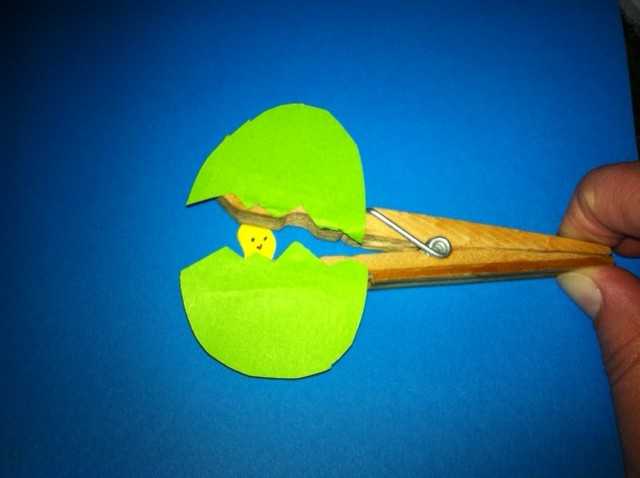
Peek-a-chick

8. Peekaboo chicks

How to : Cut a small egg shape out of card and then cut it in half horizontally (or if you’ve made collage cards just use your pre-cut egg shapes). Attach the two halves one side of a clothes peg, one at the top and one at the bottom. Draw a small chick and cut it out. Attach it to the other side of the clothes peg behind the egg top so when you pinch the peg together to the open it you’ll see the chick!

Focus on : Object permanence for babies and Knowledge of the World (eggs hatching)

9. Bunny whiskers mask

How to : Take some pipe cleaners and attach them to a lollipop stick (or two or three taped together for stability). Add a pompom for a nose and create some adorable bunny whiskers

Focus on : Role play – make bunny faces and hop like bunnies !

The wheels on the car go round and round

© Teo73 | Dreamstime Stock Photos & Stock Free Images

It’s a rare child who never has to go in the car, and an even rarer one who never fights going into the carseat or gets bored after 5 minutes making a journey less than pleasant for everyone involved. Today we’re going to look at some ideas which will hopefully make your life easier.

Earlier this year we came across a nifty little product on Twitter, called My Car Step, which attaches safely to the car seat. Invented by a mum fed up of battling her daughter, this award winning product allows children to climb into the carseat by themselves instead of being lifted, or manhandled, in. As we said in our post on tantrums, allowing children independence can defuse situations and, as a bonus this will save your back some strain, because you no longer need to perform contorted lifting manoeuvres. For nannies or childminders, who can lift multiple children into carseats on a daily basis for twenty years or more, good lifting technique and minimising strain is invaluable.

Once your little cherubs are safely attached it’s worth making the environment as comfortable as possible. Sunshades will reduce glare and making sure that the children are wearing the name number of layers as you will allow you to control the car’s temperature appropriately. Take their personal preferences into account regarding recline where possible – better that a child is happy but falls asleep upright than is reclined from the start and protests all the way. On long journeys you can stop briefly to adjust the recline to ensure they remain comfortable. Before setting off check that they have any toys within easy reach, and if necessary a drink of some kind.

Music can make journeys a lot more bearable for children, as singing along to their favourite nursery rhymes with sound effects and actions will keep them occupied. If it gets unbearable for you make a compilation of songs you all enjoy and listen to that instead. While you may appreciate the radio, young children may be bored by adverts and some songs won’t be age appropriate.

One perennial favourite is I-spy, a game with endless possibilities and several variations. Under-2s will join in looking for objects if you say ‘I spy with my little eye a bus/tractor/cow’. Preschoolers are able to identify objects associated with colours ‘I spy something red/green/yellow’ and once children are confidently recognising phonics or letters your can play the classic version.

Older children who don’t get car sick can play a version of I-spy bingo. Create some cars with pictures of different objects such as a bus, a set of traffic lights, a bicycle or a letterbox, and include some less common ones. When children see the object they can mark it on their card. The idea is to get a row, or if your feeling really adventurous, a full house. This also improves memory and recall as they will need to be able to tell you when and where they saw the objects.

Children who can recognise letters can help you make up funny sentences from the letters on car number plates. Y491 AMS makes You Are My Squishy or You Ate Many Satsumas. K920 LSC can become Katie Likes Scented Candles or Kicking Leaves Someone Crying.

Even young children can get involved in making up stories about other people on the road. This enhances social and emotional development, introduces children to situational humour, and exercises their imagination. This is especially good if you’re stuck in traffic and can see pedestrians walking by. You can pick someone who is walking by and ask the children where they think the person is going. Are they in a hurry? Why might that be?

Check our our ‘Travel with children‘ board on Pinterest for more ideas.

Finally, even if the traffic is frustrating, you’re late and it’s raining outside, keep your cool. Children will easily pick up on tension and frustration, and if you’re constantly enraged when on the road they’ll begin to associate going in the car with negative emotions. Ideally journeys should be fun and education, but most of all, happy!

We hope you find some of this helpful. What’s your fail safe technique for car journeys?