What you aren’t expecting when living and working with children

Even if you’ve got experience with children, if you haven’t lived and worked with them full time, and you’re not a parent yourself, these may take you by surprise!


1. Bumps and bruises


It’s surprising how strong these little people are! Whether you’re playing a game, taking a trip to the park or changing a nappy, you’re susceptible to bashes, knocks, and bumps which means that you’re covered in bruises yourself (especially if you bruise easily). I’m always finding bruises and trying to remember where I got them – it could be from anything, the baby dropping a toy on your foot, or an accidental kick when pushing a child on the swings!


2. Sleep


We all know that not all children sleep through the night, especially when they’re young, but what surprised me was the amount of different things that can disturb the night. From bedwetting, to ‘I just can’t sleep’, night time feeds, illness and nightmares… And then they will be up early in the morning too!


3. All things slime


Who knew how much snot and dribble could come out of those little humans! If they’re a bit older, they’ll deal with a lot of this themselves, but for young children and babies, it’s a constant battle to wipe noses, change nappies, and clear up dribble!


4. Laundry


You might have heard about how much laundry a baby makes, but did you ever think that some of that would be yours? A jumper you may have once been able to wear a few times before a wash, now might not last a full day!


5. Creatures


If your charges are at school or nursery, it is likely that they will come into contact with all kinds of germs and parasites. Think headlice, worms and chicken pox. Sadly these things aren’t contained just to the child and will most likely be spread to you, which means nitcombing and medicine for you too! Yuk!


6. Getting attached


Even after all of that, you will grow to love the little monsters. They’ll make you smile, give you cuddles and do some very cute and funny things so if you take a holiday away, expect to miss them!


Thanos for sharing, Cate! If you have something you’d like to share just drop us a line on frances@nannyjob.co.uk

Au pair vs nanny

What is an au pair?

An au pair is a young person, usually aged 17-25, who comes to the UK with the aim of improving their English and/or experiencing life in another country. They can come from any country in the European union or certain other countries which are eligible for a Tier 5 Youth Mobility Scheme Visa, including Australia, Canada, Japan and New Zealand. They live with a family (there is no such thing as a live out au pair) and are provided with a bedroom, all meals and some pocket money in return for some light childcare and helping with household chores. They should be included in family activities such as days or meals out too.

What do they do?

Au pairs usually look after children aged 3+ outside school or nursery times, although they may work alongside a parent caring for younger children or do short periods of wraparound care. They can prepare simple meals, play with children, supervise homework (although they may not be able to help), take children to and from activities and do chores such as sweeping the floor, washing up or tidying up toys.

What can’t they do?

Au pairs are not suitable for full time care, especially of young children. A reliable au pair may be able to provide a few weeks of full time care in school holidays for additional pay or time off. They also don’t do heavy cleaning such as cleaning windows or bathrooms (except their own) or family laundry.

How much are they paid?

An au pair is usually paid £70-100 per week. If they are paid above the lower earnings limit you will need to register as an employer. You may also need to register as an employer if they get another job, for example a Saturday job. You will also be expected to provide some form of transport so they can get to English classes etc unless everything is within walking distance. In London this is usually an Oyster card, outside London it is more common for an au pair to be provided with a local bus pass or bicycle or be insured on a car.


VS


What is a nanny?

A nanny is a qualified or experienced childcarer who is able to take sole charge of children on a full or part time basis. They may be of any nationality as long as they have the right to work in the UK and any age from 18 to 70+. They can live in or live out and are paid a salary, from which tax and national insurance must be deducted by their employer.

What do they do?

A nanny will take care of everything to do with the children, from feeding and changing to providing educational activities, making food and bottles to children’s laundry and cleaning their bedrooms. Some nannies are also willing to batch cook meals to freeze for the children or the family or take on PA duties such as waiting in for parcels or repairmen and picking up dry cleaning. They will supervise and help with homework and music practice and may work overnight or at weekends in a proxy parent role.

What can’t they do?

There is virtually nothing a nanny can’t do, but there are limits to what most will be happy to do. Nannies are not housekeepers, they do not usually tidy up after parents or manage the house. They also can’t fly using an umbrella.

How much are they paid?

The 2013 nannytax salary survey showed that nanny ranges varied from £318 to £672 gross for a 50 hour week. Live in wages are typically lower than live out.

Becoming a maternity nurse

Maternity nurses, or maternity nannies, are newborn specialists who work with parents for the first few weeks of a new baby’s life to help the adjust to parenthood and implement a good routine. They usually work 24 hours a day, 5 or 6 days a week, and an experienced maternity nurse can earn in excess of £1000 per week. They are self-employed and get work from agencies, advertising themselves on sites such as nannyjob.co.uk and via word of mouth. Jobs are can last between 4 weeks and 6 months so maternity nurses are always keeping an eye out for work, attending interviews and planning ahead. Maternity nurses also need to keep an eye on their accounts, keep track of expenses and submit their own tax returns.

Many families request specialist qualifications such as MNT’s Maternity Practitioner, NEST Postnatal Carer or BabyEm’s Maternity Nurse Training courses. Other courses which cover breastfeeding, postnatal depression or multiples to name just a few can also be valuable additions to your CV. Most course providers recommend that you have substantial experience with newborns before studying to become a maternity nurse so you can match the theory you learn in the classroom with your practical experiences. This experience will also give you valuable references when you are trying to get your first maternity nurse booking. Trainee maternity nurses often charge much less than their experienced colleagues in order to gain experience, work with families expecting their second or third child or take on part-time day or night work.

A maternity nurse needs to be cheerful, flexible, organised and able to cope on very little sleep. It’s not just about working with newborn babies, the goal is to involve the parents from the start and leave them feeling confident and able to look after their baby on their own when you leave, but it can be a rewarding progression from nannying into an exciting new career. If you are interested in finding out more, why not ask your questions on our community area?

Surviving emergency childcare

It happens to everyone at some point. Sick child, sick childminder or nanny, unexpected business trip, one child in hospital and siblings not allowed in or your carefully prepared backup plan for nursery closure has fallen through. You need emergency childcare. Apart from the logistics of sourcing a temporary nanny, emergency childminder or last minute nursery place there are a few things to consider. You want to make the handover as smooth and stressfree as possible for you, your temporary childcare and above all your child.


It happens to everyone at some point. Sick child, sick childminder or nanny, unexpected business trip, one child in hospital and siblings not allowed in or your carefully prepared backup plan for nursery closure has fallen through. You need emergency childcare. Apart from the logistics of sourcing a temporary nanny, emergency childminder or last minute nursery place there are a few things to consider. You want to make the handover as smooth and stress-free as possible for you, your temporary childcare and above all your child


There are many ways to find emergency childcare, via an agency or searching for temporary nannies with availability. It’s best to maximise your chances by following as many leads as possible. Once you’ve found someone don’t be tempted to skip steps – ask for at least 2 references and either request scans of their checks and qualifications or get them to bring them along so you can see for yourself before they start work.

Prepare your child as much as possible for the change to his routine by talking about the new childcare and highlighting the advantages and similarities. Reassure them that this isn’t a permanent change to their routine and they will be able to return to normal afterwards. A special comforter, blanket or cuddly toy, even if usually reserved for bedtimes, may help your child deal with the transition.

Leave a much detail as possible for your new nanny or childminder concerning your child’s routine and favourite foods and activities and, if you have chosen an emergency nanny, your house.An experienced temporary nanny will be used to parachuting in and getting on with it but it’s better to have too much detail than none at all. After all if everything is going well they may not need to refer to your speedily put together manual but should they need to know something it will make their life, and yours, a lot easier if they can just scan through to find what they need to know.

Where possible ensure sufficient time for a handover but don’t drag it out for too long. It’s hard leaving your child with someone she and you don’t know but it can be very confusing if you’ve explained that the emergency nanny or childminder is going to look after her and then you don’t leave. Tell the emergency childcarer to call you if there are any problems or your child doesn’t settle, and leave as many numbers as possible for you and your partner so you can be reached easily.

Discuss payment beforehand. There’s nothing worse than turning up at the end of the day with an empty purse to find that they are expecting cash. There’s nothing illegal about paying in cash, in fact many childcarers who take short-notice, short-term jobs prefer it as it means they know they’ve been paid. Be aware that paying in cash doesn’t necessarily mean you don’t have to deduct tax and National Insurance or a temporary nanny; some are self-employed but if they’re there for more than a few days they may be expecting you to act as their employer. If you already employ a nanny and use a payroll agency then they should be able to help you.

Prepare for emergencies by leaving a letter of consent for medical treatment. It would be exceptionally bad luck to face a trip to A&E on top of your childcare crisis but these things can happen and it’s safer to be prepared.

Finally, give yourself permission to make the day as easy as possible. The housework can wait, dinner can be the freezer’s finest or a takeaway, take a taxi – surviving emergency childcare is tough enough without extra work.

Hopefully you and your child will come through smiling, and even asking for your temporary nanny to come back!


The Pufflympics

Stuck for ideas? Why not try a themed activity week?! Nanny Claire has done weeks of activities centered around Princesses,  cars and space, and here she shares her Winter Olympic theme with a twist.


I’m a nanny and look after 3 children, two girls E 12 years old and AM 6 years old and one boy AC 9 years old. My job is usually part-time, I do the school run and then ferrying around various after school activities and playdates. However, there are times that those who look after children dread…the school holidays.

I had not given much thought as to what we were going to do all week, swimming, movies and playdates were confirmed but they don’t take up the whole week. On Monday the kids were having breakfast and it just so happened that the Winter Olympics were on, so especially with sports obsessed AC, we  were watching the curling. I’m usually quite strict on TV hours, switched off after breakfast until at least 4:30pm, but the Winter Olympics is not on every  week so it’s an exception to the rule.

As most of us who look after children know, it’s not long before we get the inevitable phrase “What are we going to do today?”, one of the kids said that curling looking fun so I said I bet we can find something to do curling with if you get washed and dressed, at which point they vanished like speedy ninjas.

So now I had to find something to play curling with, I wandered around looking at the various toys and then I saw the puffles…If anyone doesn’t know what a puffle is, they are pets for penguins on the popular Club Penguin game, they are basically small round, come in various colours and have fuzzy hair. There happen to be quite a few in the kids collection, kind of curling stone shaped and should slide across the floor quite nicely!

The weather outside was typically pouring down with rain, so I tested some chalk on the kitchen tiles just to make sure it would come off  later (not my floor after all!), no problem there so I sketched out some circles to represent the house in curling, got the brush out of the cupboard  and we were ready to go! There was soon puffles flying in all directions and much laughing, arguing and cheering. We decided that scoring would be whoever got their puffles closest to the middle on their turn, I didn’t expect the game to be such a big hit and the kids asked what other events we could do.

So we looked up the other Olympic sports there were, and I tried to work out how we could replicate them at home, a brief thought of kids  sliding down the stairs on trays entered my mind swiftly followed by thoughts of a trip to A & E. However bob sleigh could work, if we made them for the  puffles and not the kids. So at dinner I told the kids we were going to be making bob sleds for the puffles tomorrow.

On Tuesday morning I was greeted with much excitement, “Are we still making sleds for puffles today? After breakfast I raided my box collection, always have a variety of empty boxes for such rainy days, I cut down 3 boxes to the same size for each of them, out came the glue, and various arts and crafts paraphernalia. There was much discussion about what would make it slide better, runners on the bottom, aerodynamics, making it look pretty, etc.


I fashioned a slide out of some cardboard box strips and white bin liners, and put it on the stairs, we then timed each puffle and recorded the time. The kids spontaneously decided to create a team name and made-up country for their puffles, so we then had team Fermat for E, team Mouseling for AM and team I Don’t Know for AC, they created maps for their countries and an event chart went up on the wall, all their own ideas I’m proud to say.
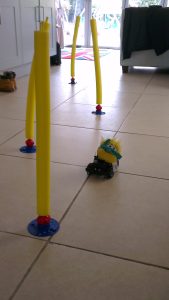


The pressure was now on me to come up with the next day’s event, thinking of the events involved I decided that the Ski slalom was possible with a little help from a remote control car! This did involve tying the puffle to the car under the pretence of a seat belt, and the kids made crash helmets out of craft foam for them! The kids have a building set called Cranium which is a set of poles and cloths which can be constructed to create play houses, etc. and the poles turned out to be quite useful for slalom flags. We opted for the rule of having to go around 2 poles at least and not all of them, this way they all had a good chance to get around the course successfully. They had plenty of time to practice driving the car before we did individual times and recorded them on the event sheet, needless to say puffles and poles went flying in all directions!

I went home that night and dreamt of puffles, and how to do the next event! I decided that I could recycle the bob sled run into a ski jump  and use the remote control car again; we used a sun lounger cushion so we didn’t mangle the car. I admit the car was very slow but managed to construct  the jump so if you lined up well you could get the car to do a small jump off the end, sufficient enough to get a small measurement anyway. The kids all got  to practice again before we took some final measurements. This wrapped up the final event of the Pufflympics, the next day was Friday and the last day of the holidays.

We decided to host our own closing ceremony; a toy shopping trolley became a puffle parade float with a few adaptions of course. The kids designed their own part of the float to put their puffle on to reflect their team and country. Next was designing their own podium step, E helped me make some medals by gluing some sequins to stickers and then cutting them out. E made a party playlist on her iPod and wrote a speech, AC lined the parade route on the floor with string and AM helped me get some food ready. It was junk food heaven as I let them have full reign on what food they wanted, so we had hot dogs, pizza, chips, cheese sandwiches and squishy tomatoes (AM really really likes cherry tomatoes roasted until extremely squishy)!

So after a busy week hosting the Pufflympics the kids had been entertained all week when it was generally too rainy to go outside, and I hadn’t been driven mad by kids asking what they can do every 10 minutes. Most importantly we all learned a lot more about the winter Olympic sports, lots of fancy new words and rules and at a fraction of a cost compared to the real thing. I essentially used toys and things we had in the house, the kids had a blast and spontaneously  added lots of their own ideas of what they could do. If you fancy hosting your own event you don’t necessarily have to have puffles on hand, cars would also have made great competitors for the Carlympics or a variety of cuddly toys for the Cuddlympics? You don’t need to be confined indoors or to the Olympics either. Why not host the World Cup or the Commonwealth Games outside?

First Aid for childcarers

One of the most common requirements for childcarers is a valid paediatric first aid certificate. All registered child minders have to hold this, as well as OFSTED registered nannies. Nurseries only have to have one member of staff trained but it’s good practice for most, if not all, staff to have done a course.

Accidents can happen at any time and frighteningly quickly. One of the biggest risks for small children is choking. The leading First Aid organizations in the UK have just published new guidance for managing choking in a baby. Instead of lying the baby along your arm and giving back slaps to dislodge the blockage they now recommend putting the child face down across your lap to administer back slaps. Changes like this are part of the reason a First Aid certificate should always be within date and fully renewed every 3 years.

It’s important to make sure the certificate specifically covers paediatric first aid as some treatment is different for children that won’t have been covered on an adult course.

Thorough First Aid training means a childcarer should feel confident about handling an incident and this will help them stay calm and remember what to do. A course should also involve hands on practice to ensure the techniques are correctly understood. No amount of reading can replace this practical component.

We urge parents to ensure their nannies and babysitters are trained in First Aid and support this petition to make it a legal requirement for all nursery worker to hold a First Aid certificate too. Please take a moment to read and sign.

First Aid courses are available through organisations such as the Red Cross and St John’s Ambulance, private providers and many nanny agencies.

How to keep your nanny – 10 ways

A while ago we posted a tongue in cheek post ‘How to lose your nanny in 10 days‘. Hopefully you’ve avoided making most of these mistakes and have a happy, settled relationship with your nanny. As the festive season looms (to be followed by that horrid January slump) we thought now might be a good time to look at ways you can keep your nanny happy.

  • Remember that one-off gestures are all well and good but the best way to keep your relationship (be it with your nanny or anyone else in fact) is constantly paying attention to the little things. Respecting your nanny will go a long way to ensuring their happiness and if you don’t have time to click on the link RESPECT stands for Rights, Earnings, Space, Professionalism, Expenses, Choices and Time. It’s worth just repeating that last one – your nanny’s finish time is the time they should be walking out the door, not the time you walk in. If you find yourself being persistently late then consider extending your nanny’s hours and paying for that time.
  • Make allowances, because your nanny is a person too, for the occasional late start (whether it’s a public transport mishap or a sleepy alarm clock) or off day. Allowing them to go early on occasion will make them a lot more tolerant of your occasional lateness (be it public transport or a meeting that overruns).  An unscheduled early finish rates pretty highly among the various perks nannies get, by the way! In the same vein appreciate the restrictions your nanny has on their time and let them run personal errands during work hours occasionally.
  • Get them a takeaway when they babysit, and if you have a netflix account or similar encourage them to use it. Or if they prefer to cook for themselves leave a bit of extra cash so they can pick up some special ingredients and have a nice meal.
  • Don’t skimp on sick pay if you can afford it. The odd bug happens to everyone and it’s doubly unfair for a nanny to have an unpaid sick day because they’re throwing up as a result of your little darlings’ generosity with their germs.
  • Let them use the stuff in your house. If you have a Kenwood Chef or a KitchenAid stand mixer and an enthusiastic baker for a nanny who’s planning to make her best friend’s birthday cake with a hand held beater from Tesco then let her use your kitchen one day. If their washing machine breaks down then instead of letting them trek to the launderette put your washing machine temporarily at their disposal. It might bump up your bills a bit but it’ll bump up goodwill even more.
  • Invite your nanny as a guest to significant events for the children like birthdays and christenings, unless you want them to work in which case pay them overtime. Chances are they won’t come but most nannies will appreciate that you think of them as part of the family.
  • Remember them on their birthday and at Christmas (or equivalent major religious festival that you or they celebrate). You don’t need to give an extravagant gift or a month’s salary as a bonus to show your appreciate them and all the work they do. Something small and personal with a voucher for their favourite store will probably go down well. Photographs of your children in expensive frames, while lovely to look at, aren’t a winner unless it’s a leaving gift.
  • Review their performance and their pay once a year. If you can’t afford a pay rise then try and show them you appreciate their work in another way, or give them some extra holiday as a reward for staying with the family. The very least you can do is point out what a great job they’ve done through the year and all the times you’ve noticed and appreciated them going the extra mile. 
  • Recommend them if they want extra babysitting and you know someone who wants a sitter. If your nanny doesn’t want to babysit then point your friend in the direction of our free babysitting section!
  • Finally…. Say thank you. Every day. Without fail.

Separation Anxiety

Separating from their primary carer is a difficult experience for babies, and their parents too! In this post we look at some of the causes of separation anxiety and strategies to help.


What is separation anxiety?

Most people equate separation anxiety with crying and clinginess to a familiar adult. Separation anxiety is a natural stage that most children experience for the first time between 7 and 12 months. It’s a perfectly normal reaction to being parted from their primary carer. Unfortunately it also often coincides with a child entering childcare for the first time as a parent goes back to work. By the time a child is 2 years old, separation anxiety should have calmed down, although they may still be anxious or nervous about staying with an unfamiliar adult or in an unfamiliar place the first time it happens. Children (and adults) continue to experience some symptoms of separation anxiety even when they can rationalise what it happening. This can often be seen in parents leaving their child for the first time!


What causes separation anxiety?

Separation anxiety occurs when babies realise that things and people exist even when they can’t be seen. Babies realise that they are alone and feel that there should be someone there, so may cry in the night if they wake and find themselves alone or cry if you leave the room, or they feel anxious when a familiar adult leaves, even if there is someone to look after them.


What can help?

This depends on what is causing the anxiety and the extent you’re prepared to compromise what you do.

If a baby experiences separation anxiety every time you leave the room one option is to take them with you. At some stage they will outgrow their anxiety but this isn’t always practical.

Another strategy is to practice, first by playing peekaboo or hide and seek and then leaving the room and popping back in frequently. Say that you’re going and you’ll be back soon, and don’t worry if you can only manage 10 seconds at first. The most important thing is that you leave and come back.

Children will often experience less separation anxiety if left with another familiar adult so try to balance time spent with Mummy where Daddy leaves and time spent with Daddy and Mummy leaves. A child will feel more secure about the absence of one parent because the other parent is still there. Having other familiar adults – extended family, neighbours or friends – who will stay while you leave, even if it’s just to make a cup of tea, will acclimatise them to being without you without being alone.

At night or nap time do comfort a child but keep visits short and try to avoid lots of interaction. Their separation anxiety is real and distressing for them and they need to know that you are there. If they are unable to fall asleep because they are so distressed try the gradual retreat method where you put them in their cot and sit beside them, gradually moving further and further away until you are out the door. It may take a while and you need to be consistent but it is a gentle way to help them overcome their fear.


Separation anxiety and childcare – some advice for parents.

Children who have only ever been in the care of their parents naturally experience separation anxiety when they enter childcare or school.Children who are used to being around a wide range of familiar adults, for example extended family, are less likely to protest when Mummy or Daddy leaves although they are still likely to experience some separation anxiety. The transition just feels easier because they are accustomed to you leaving and coming back and you are used to leaving them.

It’s important to have a settling in period with a childminder or nursery, or a handover with a new nanny. Build up to a short day by first leaving for short periods, then half days and eventually a full day.

Make sure you always say good-bye when you go, and childcarers should always say good-bye at the end of the day too. Once you have left resist the temptation to pop back and see how they’re doing and then leaving again – this is confusing for children.

Always be positive about your chosen childcare. If your child senses that you are nervous or unsure they will pick up on this and feel unsettled too.

Safer baby sleep

This is a guest posting from The Lullaby Trust. The Lullaby Trust, formerly FSID, promotes expert advice on safer baby sleep and provides specialist support for bereaved families.

Working with a baby or toddler can be an exciting and rewarding experience. However, we know how worrying it can be making the best decisions to keep babies and toddlers as safe as possible.

Sudden Infant Death Syndrome (SIDS) is the sudden and unexplained death of a baby where no cause is found. While SIDS is rare, it can still happen and our advice below will ensure that the baby or toddler in your care is sleeping as safely as can be both a night and during the day.

Things you can do when working with a baby:

Always place the baby on their back to sleep

• You should always place the baby on their back to sleep and not on their front or side

• Make sure you and the family you work with are consistent with back sleeping- the chance of SIDS is particularly high for babies who are sometimes placed on their front or side

• Once the baby can roll from back to front and back again, on their own, they can be left to find their own position

Keep the baby smoke free

• Never smoke around the baby or have the baby on contact with smoky skin or clothing.

• Don’t let people smoke near the baby and keep the house, car, and other places the baby spends time, smoke free

Opt for expressed breast milk over formula

• If you have the option, always prioritise breast milk over formula, as this can be protective against the risk of SIDS

Place the baby to sleep in a cot or Moses basket in the same room as you for the first 6 months, even during the day. It’s the safest place.

• The chance of SIDS is lower when babies sleep in the same room as their parents or carers, but do not share the same bed as them

Ensure the baby has a firm, flat, waterproof mattress in a good condition

• You and the baby’s family should avoid using soft or bulky bedding (such as quilts, pillows and duvets) as these increase the chance of SIDS

• Sleep the baby on a firm, flat mattress that is clean and in a good condition. A mattress with a waterproof cover will help you keep it clean and dry


Things to avoid when working with a baby:

Never sleep on a sofa or in an armchair with the baby either next to you or on your chest, even during the day

• Sofa sharing with a baby greatly increases the chance of SIDS

Avoid letting the baby get too hot or too cold

• A room temperature of 16-20⁰C, with light bedding or a lightweight well-fitting sleeping bag, is comfortable and safe for sleeping babies

• Check the baby regularly to see if he or she is too hot. Look for sweating or feel the baby’s tummy – their hands and feet will usually be cooler, that’s normal. If the baby is hot, remove one or more layers of bedclothes.

Don’t cover the baby’s face or head while sleeping or use loose bedding

• The use of loose bedding which can cover the baby’s face or head can be dangerous and can increase the chance of SIDS

• To keep the baby safe and their head uncovered while they are sleeping you should:

o Place your baby on their back in the ‘feet to foot’ position – this is where the baby’s feet are placed at the foot of the cot – so they can’t wriggle down under the blankets

o Use blankets which are firmly tucked in, no higher than the baby’s shoulders or baby sleeping bag

For more information and advice, see the Lullaby Trust’s website at www.lullabytrust.org.uk, or phone the information and advice line on 0808 802 6869.

Happy nannying!

More Great Childcare

The biggest changes to childcare in a decade were announced early this week. A report, entitled More Great Childcare, was sent out by Elizabeth Truss MP, the Minister with responsibility for early years. Two major changes were proposed: relaxing the adult:child ratio for childminders and nurseries and setting out new plans for qualifications. This is the first of two blog posts on the report – first we’re going to look at ratios and the second post will be about qualifications.


What are the changes?

For nurseries the ratios will become 1 adult to 4 babies and 1 adult to 6 toddlers with no change to the ratios for pre-schoolers.

Childminders will still be allowed to care for 6 under 8 but routinely 4 under 5, of which 2 can be under 1 instead of 3 under 5, 1 under 1.

There is no change affecting ratios for nannies.


We spoke to Penny Webb, a childminder with 30 years’ experience who starteda petition against the changes. She currently uses the exception granted under EYFS2012 to regularly care for four or five under-5s on grounds of continuity of care.


I am shattered every day, I am doing more tasks in my own time that used to be able to fit into the working day. I am passionate about childminding – the children will always come first and will always experience outstanding care and education but I know that I can not maintain this level of commitment and this level of effort long term.” Penny Webb, Childminder


She also warns against the impact on children of childminders who rush into caring for too many children at once with little or no experience. Even as a mother of four and with many years of professional experience she has been surprised by how tiring her current workload is. 


“I do know people will do it for the money – I also think some will take on more children – with best intentions and then ‘crash and burn’. This will be bad for the children as either will stay with that minder and not have the best experiences – or the minder will be honest and the child will have to go to a different setting – very bad for emotional development.” Penny Webb, Childminder


That’s without even getting started on the lack of space in most homes for 4 under-5s, the difficulties finding triple prams, the cost of a seven-seater and car seats, and the sheer enormity of keeping 4 under-5s safe when out and about. The Minister also shows no sign of allowing OFSTED to slacken their regulatory role, intending to make them the sole authority over childcare settings (the role is currently shared with Local Authorities). This means the paperwork burden on childcarers who are obliged to follow EYFS will go up by 30% for childminders and 50%  for nursery staff.


Em, a former nursery worker who is now a nanny, highlighted that current arrangements already impacted to the interaction she was able to have with the children ‘to their disadvantage’. She feels becoming a nanny gave her freedom to really bond with children and follow their interests, and the care the children receive is better for that.


“That kind of ratio would seriously change my mind about nursery work [in the future] especially with the paperwork burden on nursery staff at the moment let alone with more children in their care. It’s insane!” Em, Nanny


Private nurseries in favour of the changes have been accused of only being interested in profit however Sarah Steel, MD of The Old Station nursery points out that any cost saving from relaxed ratios is likely to be eaten up by increasing quality, paying staff a higher wage and subsidising Early Years funding. The most worrying consequence she sees is a potential two-tier system.


“Those in most deprived areas, where nurseries are already struggling to survive, will have to embrace lower ratios, but this may be at the cost of quality.” Sarah Steel, MD, The Old Station Nursery


This is most evident in areas which are supposed to offer funded places for 2 year olds, an age group where the number of children per adult has been increased by 50% and where struggling nurseries may have no choice but to make ends meet by reducing staff costs. Even experts are unsure that more children per adult will lead to a reduction in cost. Eva Lloyd, from the University of East London, said there was no relationship between ratios and cost to parents. She is also sceptical that higher quality will be possible under the proposed changes and it’s easy to see why. The most highly qualified childcarer is physically limited in the number of children they can safely care for or comfort at once. Higher ratios may effectively prevent them from deploying their knowledge and reduce them to refereeing hordes of toddlers. The members of the PLA  seem inclined to agree and Laura Henry, an early years consultant but also parent of two boys, posted an impassioned letter on her blog aimed at parents.


Even though the changes proposed don’t mention nannies it would be naïve to assume they won’t somehow be affected. On the one hand it’s good news for the sector – parents who are unhappy about the quality of care offered by local childminders or nurseries may look into a nanny or nanny share. A nanny with 4 under 5 would still be able to dedicate more time to his/her charges because nannies are not required to provide reams of paperwork for OFSTED inspections. On the other hand parents may find it more difficult to find quality candidates. It doesn’t take a GCSE in maths to work out that reducing the required number of adults to care for a roomful of 12 toddlers from 3 to 2 leaves a member of staff without a job. The BAPN expressed concern that the nanny market may become flooded by nursery workers who have been made redundant because they are no longer perceived as fit to work in nursery settings, leaving an entire sector of the market lagging behind in terms of quality.


Many parents are unhappy about the changes. The online parenting forum Mumsnet revealed that only 5% of members surveyed polled in favour of relaxed ratios and Netmums reported a figure of 20% in favour. They may still be faced with an impossible choice, to pay over the average for a provider with low ratio and high quality care or accept lower quality care for lower cost. Parents who are unable to get spaces in settings offering coveted lower ratios may stretch themselves to pay for a nanny until the funded hours kick in at 3 years old, an age group unaffected by the ratio changes.