Questions not to ask at interview

Interviewing can be a nerve wracking process and it’s understandable that families want to find out as much about their potential nanny as possible, but there are certain questions which should be avoided in case they lead to direct or indirect discrimination.

In some cases you may have reasons for wanting to know the information and feel that bring direct and open is the best way, but you must phrase your questions carefully so they are supported by a legitimate need and do not leave you open to claims of discrimination.

“Are you married/in a relationship?”

Why it’s bad: Questions about marital status can be seen as discrimatory, or trying to find out about sexual preferences.
Why you might want to know: If you’re hiring a live in nanny you might want to know whether they’re going to move their partner in too, or whether you’ll be waking up to a string of different ‘houseguests’
What you can say: “Would you expect to have guests to stay?”

“Do you have children?”

Why it’s bad: A nanny could claim that you discriminated against them if you didn’t give them the job and gave it to someone who didn’t have children.
Why you might want to know: A whole host of reasons, including whether the nanny is likely to want to bring their children to work regularly or occasionally or whether they have their own children to pick up from childcare, thus reducing their flexibility.
What you can say: “Do you have any obligations at home which may interfere with your attendance or ability to do this job and how do you plan to minimise the impact of those?

“Are you planning to have children soon?”

Why it’s bad: This is definitely discriminatory – although you are trying to reduce the impact of an employee going on maternity or paternity leave it’s illegal to ask this question.
Why you might want to know: A nanny planning to start a family will mean you need to find alternative childcare to cover the leave they are entitled to.
What you can say: Nothing. This is a risk you need to be prepared to take.

“Do you have a disability?”

Why it’s bad: Asking someone whether they have a disability contravenes legislation on equality.
Why you might want to know: Some disabilities may impair a nanny’s ability to do their job.
What you can say: You can focus on whether the applicant is able to do the job e.g. “Are you able to lift and carry my toddler?”. You can also ask whether you need to make reasonable adjustments once a job offer has been made. As an employer it is up to you to decide what is ‘reasonable’ in terms of your requirements. You may not be able to adjust working hours, for example, but you may be able to accommodate time off for treatment on a regular basis. If you are in any doubt we suggest you seek specialist advice.

“How old are you?”

Why it’s bad: Knowing someone’s age could lead to a claim of age discrimination. You must focus on someone’s ability to do the job, whether old or young.
Why you might want to know: Nosiness!
What you can say: Nothing.

“Where do you come from?”

Why it’s bad: Nationality and ethnicity should have no bearing on someone’s suitability as a nanny.
Why you might want to know: If you require your nanny to travel or if you have concerns about their right to work in the UK (which you should verify in any case) you may feel reassured by knowing their nationality. You may also think this is a friendly question inviting the nanny to talk about themselves. In rare cases it may be a genuine occupational requirement that a nanny holds a particular passport.
What you can say: “Are you able to travel within the EU without restrictions/to X with the appropriate visa?” “Can you provide evidence of your right to work in the UK?”

“What religion are you?”

Why it’s bad: This question is grounds for claiming discrimination.
Why you might want to know: If you want your nanny to support your religious practices you might think the simplest way is if they belong to your religion.
What you can say: “We are Jewish/Hindu/Catholic and would like you to respect our traditions and support our children in their religious development. Do you feel comfortable doing that?”

Separation Anxiety

Separating from their primary carer is a difficult experience for babies, and their parents too! In this post we look at some of the causes of separation anxiety and strategies to help.


What is separation anxiety?

Most people equate separation anxiety with crying and clinginess to a familiar adult. Separation anxiety is a natural stage that most children experience for the first time between 7 and 12 months. It’s a perfectly normal reaction to being parted from their primary carer. Unfortunately it also often coincides with a child entering childcare for the first time as a parent goes back to work. By the time a child is 2 years old, separation anxiety should have calmed down, although they may still be anxious or nervous about staying with an unfamiliar adult or in an unfamiliar place the first time it happens. Children (and adults) continue to experience some symptoms of separation anxiety even when they can rationalise what it happening. This can often be seen in parents leaving their child for the first time!


What causes separation anxiety?

Separation anxiety occurs when babies realise that things and people exist even when they can’t be seen. Babies realise that they are alone and feel that there should be someone there, so may cry in the night if they wake and find themselves alone or cry if you leave the room, or they feel anxious when a familiar adult leaves, even if there is someone to look after them.


What can help?

This depends on what is causing the anxiety and the extent you’re prepared to compromise what you do.

If a baby experiences separation anxiety every time you leave the room one option is to take them with you. At some stage they will outgrow their anxiety but this isn’t always practical.

Another strategy is to practice, first by playing peekaboo or hide and seek and then leaving the room and popping back in frequently. Say that you’re going and you’ll be back soon, and don’t worry if you can only manage 10 seconds at first. The most important thing is that you leave and come back.

Children will often experience less separation anxiety if left with another familiar adult so try to balance time spent with Mummy where Daddy leaves and time spent with Daddy and Mummy leaves. A child will feel more secure about the absence of one parent because the other parent is still there. Having other familiar adults – extended family, neighbours or friends – who will stay while you leave, even if it’s just to make a cup of tea, will acclimatise them to being without you without being alone.

At night or nap time do comfort a child but keep visits short and try to avoid lots of interaction. Their separation anxiety is real and distressing for them and they need to know that you are there. If they are unable to fall asleep because they are so distressed try the gradual retreat method where you put them in their cot and sit beside them, gradually moving further and further away until you are out the door. It may take a while and you need to be consistent but it is a gentle way to help them overcome their fear.


Separation anxiety and childcare – some advice for parents.

Children who have only ever been in the care of their parents naturally experience separation anxiety when they enter childcare or school.Children who are used to being around a wide range of familiar adults, for example extended family, are less likely to protest when Mummy or Daddy leaves although they are still likely to experience some separation anxiety. The transition just feels easier because they are accustomed to you leaving and coming back and you are used to leaving them.

It’s important to have a settling in period with a childminder or nursery, or a handover with a new nanny. Build up to a short day by first leaving for short periods, then half days and eventually a full day.

Make sure you always say good-bye when you go, and childcarers should always say good-bye at the end of the day too. Once you have left resist the temptation to pop back and see how they’re doing and then leaving again – this is confusing for children.

Always be positive about your chosen childcare. If your child senses that you are nervous or unsure they will pick up on this and feel unsettled too.

Show your appreciation


6-13 May is Nanny Week in the UK, dedicated to the amazing childcare professionals who provide loving care for children in their own homes day after day. A good nanny is more than an employee, they become a vital part of the family, and deserve some appreciation. Obviously nothing replaces being a good, considerate employer all year round, but a little extra can go a very long way.

We asked over on our Facebook page what nannies would like their employers to do to show their appreciation this week, and top of the list was saying ‘Thank You’ – 2 simple words that make a huge difference because they mean that you have noticed what your nanny does and are grateful for it. It doesn’t cost you anything but it will mean the world to your nanny.

If you are in the mood to spend a little more time, effort or cash then coming home early unexpectedly and letting your nanny go home is a great bonus. Getting them a nice cake to have with tea or coffee during nap time, or making sure the fridge is stocked with their favourite snack is another little gesture to show them you care.

Showing your appreciation all year round will make your nanny feel valued, but if you’ve got into the habit of treating them as part of the furniture make a special effort today to show them just how much they mean to you.

How to lose your nanny in 10 days

© Tofi | Dreamstime Stock Photos & Stock Free Images


1. Don’t sort the paperwork

Ideally you should have a contract in place before your nanny starts, but if you don’t then make signing one a top priority. Aside from being a legal obligation on your part, it’s a good idea to have the arrangement clarified in writing. You’ll also need her bank details and her National Insurance number, as well as her P45 from her previous job, to pay her correctly.


2. Don’t say thank you

It’s nice to say thank you to your nanny at the end of every day, but it’s absolutely vital if she goes out of her way to do something, whether you’ve asked her to or not. You might be paying her but a little gratitude goes a long way.


3. Go back on your word

The relationship between a nanny and employer is based on mutual trust and respect. You trust her to care for your children and she trusts you to keep your end of the bargain. If you agree to something, be it going to a specific playgroup or that she can leave half an hour early one day, don’t suddenly turn around and say you’ve changed your mind and it’s no longer possible.


4. Tell her she can’t sit on your chair

It’s understandable that even though you’ve let someone into your home you’ll still want to keep a bit of privacy, but do remember that it’s your nanny’s place of work where she will spend a great deal of time, and it’s vital that she feel comfortable. Dictating where she can and can’t sit is petty, and slights like that won’t make for an easy working relationship.


5. Be late without notice

Emergencies happen, that’s one of the reason why a nanny is such a great form of childcare, but it absolutely doesn’t excuse lateness with no warning. If your nanny finishes at 6, you haven’t left the office at 5.30 and you know it takes you 45 minutes to get home, you’re already late. Take a moment out of whatever you’re dealing with to call your nanny and apologise. Remember she may have plans for the evening too so she may not be thrilled with the news.


6. Don’t top up the kitty or reimburse her for expenses

If you ask your nanny to pick up essentials, such as nappies or bread, or expect her to take your children to activities then it’s expected that you pay for it. It’s courteous to provide a kitty for your nanny so she doesn’t have to fund day to day expenditure out of her own pocket, but if this is the arrangement you have make sure you pay her back promptly.


7. Leave a critical note, but don’t suggest improvements

Nannies don’t have mind-reading superpowers (for people over the age of 3, that is) so any time you need to tell your nanny you’d rather she did something a different way, tell her how you’d like it done. Also make sure you give any constructive criticism face to face – it can be really demoralising when someone is nice to your face and then an hour later you discover they weren’t happy at all.


8. Ask her to clean your bathroom

Most nannies will happily take care of nursery duties – that is chores related directly to the children such as cleaning up after meals, doing their laundry and hovering their bedrooms and playroom. Although some nannies will be happy to take on additional housekeeping duties, cleaning your bathroom is a step too far. Remember the top priority for a nanny is always the children.


9. Take a day off to follow her around

You probably don’t work too well with your boss breathing down your neck and your nanny is no exception. It’s difficult to interact naturally with children, sing, dance and be silly, if you know someone else is judging your every move. Added to that, children always behave differently when their parents are around, so any judgements you make are likely to be based on unsound evidence.


10. Don’t pay her

As much as your nanny probably loves her job, as a professional she does expect to be paid. Non-payment is a breach of contract, and your nanny would be perfectly justified in leaving immediately.

Continued life and Thymes

Kuvona | www.dreamstime.com
Like many other families who employ a nanny, we use a nanny/parent diary to communicate with each other and write down important messages. This is recommended by practically every book, website, parent at playgroup and nanny at interview. Of course it takes a bit of trial and error to get right….

When we started I obsessively wrote down everything, and I mean everything – nappies, precise waking times, feed timings to the last millisecond. Ellie, to be fair, played along and I have an excruciatingly thorough account of the first six weeks. Sin #1, overinformation.

Then I got lazy and days went by (possibly up to s week) when I didn’t even read the thing let alone write something down. When I did it was a quick note, mostly critical, and this is where we came to our first cropper. Sin #2, underuse.

One Sunday, slightly exasperated that Ol seemed to have no clothes, I flipped to Monday and scrawled “please make sure you do a wash on Friday so we have enough clothes for the weekend”. Monday evening I came home and, remembering that I’d left something in the diary, checked to see the reply.

“Wash was done Thursday. Please see April 9 re: sorted clothes and April 11 re: suggested purchases.”

Oh.

Now had I actually talked rather than relying on just writing I might have discovered that Ellie, in a bout of efficiency had sorted through Ol’s clothes and he only had about 5 outfits which fitted (hence the follow up note on the Friday), and of course because it was in the diary it was assumed that the message had been read and understood. Wrong. To compound this, instead of politely asking Ellie to do the laundry (whereupon I would have discovered that she actually did), I wrote a snippy note in a fit of pique. Sin #3, relying on the diary and sin #4, writing something in a way you’d never say it.

Things jogged along nicely for a while, but then I committed sin #5 (diarising something before it was confirmed). I put something in the diary 3 weeks in advance, because I knew we’d need a babysit, and this happened over a weekend so I didn’t want to text to ask there and then. I had it in the back of my mind to bring it up very quickly Monday, just to say there was something in the diary, but, fairly predictably, I forgot. Luckily I have a very understanding and organised nanny who looks through the month ahead every Monday (which is the only reason Granny got a handcrafted birthday card this year) and who called to ask whether we wanted her to babysit

Far be it from me to tender advice…. but I’ll go you 2 bits anyway.

Use your diary judiciously – not too much, but not so little that you never look at it and miss important info

AND

Never use your diary as a substitute for talking, even if its just to say “did you see the diary?”

Pizza Thyme

© Kuvona | Dreamstime.com

As we all know small children have an unfortunate habit of repeating snippets of conversation they’ve overhead at inconvenient times. They parrot back words and phrases that they’ve overheard, frequently without you even knowing that they’ve overheard and sometimes that you didn’t particularly want them to hear.

We instituted a no swearing in front of the child rule after Ol’s thirty-second word was ‘oh c**p’, used in context I hasten to add, and needless to say it doesn’t figure on the list of ‘My First Fifty Words’ that every paranoid first-time mother fills in. Other than that, though, we’ve got off fairly lightly so far. Or at least I thought we had.

Every now and again Ellie will recount something with an unholy amount of glee. I’ve learnt to be wary of a conversation at the end of the day which starts with a meaningful ‘so…’.

‘So…you know you keep a box of tampax at toddler height in the downstairs loo?’

‘So…your son overfilled his nappy today and had an impromptu bath just before lunch.’

‘So…he’s really mastered the whole spoon as a catapult thing now.’

I have a rule that if I can get in the door, put my bag down, hang my coat up and get the kettle on without hearing ‘so…..’, I’m safe.

The other night I came in as usual. Bag down, check. Toddler anchored to the ankle, check. Coat away, check. Toddler into the arms, smothered with kisses, and released. Check. Kettle on, check. Relax.

Ellie shoots me a mischevious glance.

“Ol, poppet, what did you want for dinner?” she cooed sweetly.

“A PIZZA!” Ol announced proudly. I spin my head round so fast my neck practically breaks.

“Shall Ellie make you pizza?” she asked.

“No, telephone a pizza,” he said seriously, toddling off into the hall. I covered my face with my hands.

“We don’t have takeaway pizza that often,” I begin. Ellie shoots me a look which immediately conveys that she knows I’m lying and it doesn’t really matter whether we have pizza every night she doesn’t leave something for us.

Ol reappears with the cordless phone and presses some buttons. Thankfully the keypad on this actually locks, something a childless person wouldn’t have known or thought about when buying said phone but pretty useful when you discover that it does.

“Yes, hello. A pizza?” Ol cocked his head to one side. “Okay. A pepperoni and a veggie supreme……Half hour great okaybye. Bedtime Ollypop”.

Ellie falls about laughing. I feel a giggle rising up inside me too. It’s cute, admittedly but three embarrassing things.

One that our son is practically able to order our pizza for us.

Two we obviously have pizza so often they know our voices and address without even asking.

Three we order it so frequently just before putting him to bed that he tags ‘bedtime Ollypop’ onto the order.

Oh the shame….Maybe we’ll have Chinese tomorrow.

9 nifty Easter activities

Welcome to our #9nifty series. We’re starting with 9 Easter activities for kids of all ages…


1. Eggs inside eggs

This was tricky for the 2 year old!

How to : Put little foil wrapped chocolate eggs into a ballon and blow it up, cover with the outside of the balloon with glue then wrap string/wool/embroidery thread around it (leaving enough space to take the balloon pieces out but not so much that the eggs can escape) and glue again. Hang them up to dry and when they’re ready pop the balloon and take the pieces out carefully ! Experiment with blowing the balloon up to different sizes or different types of string.

Focus on : Fine motor skills


2. Chocolate easter nests

How to : Melt chocolate, mix with shredded wheat, shape into nests and allow to cool!

Focus on : Numeracy/science – pouring and measuring, melting and solidifying


Simple yet effective...

3. Silhouette bunnies

How to : trace around the bunny, or make a stencil to paint over and make a fluffy cotton tail to stick on!

Focus on : Understanding the world/The World and Traditions in other countries. Talk about the Easter bunny who bring the eggs. Some other countries have the same tradition although in Sweden, Austria and Germany it’s a hare and in France it’s the bells who bring the chocolate ! What’s the tradition in their family ?


4. Easter egg scavenger hunt

How to : Hide your Easter eggs around the house or the garden and write clues. Read the clues together and find where the eggs have been hidden !

Focus on : Problem solving and memory skills

Upcycled junk mail makes a pretty egg!

5. Collage Easter egg cards

How to : Fold A4 paper/card into half and then half again. With a craft knife cut out a shape of an egg from one qurter, this will be the front of your card. Make a collage onto thenow exposed quarter (you might want to mark it while it’s folded) and wait for it to dry. Refold and admire the colourful egg !

Focus on : Colour recognition and decision making.

6. Hand and footprint bunny

How to : Make handprints and footprints in pink paint and cut them out, leaving a reasonable margin. Take 2 paper plates and cover them in cotton wool. Join them together to create the head and body of the bunny. Stick on some googly eyes, black pipe cleaner or strips of felt for whiskers , a pink heart for a nose, the hand prints for ears and the foot prints for feet.

Focus on : Talking about textures. This is a sensory rich activity with sloppy, sticky paint and fluffy cotton wool.

7. Easter bonnet

How to : Buy a cheap wide brimmed hat, or improvise ! Decorate the hat by painting it or covering it with fabric, cut egg cartons open and paint them to make flowers, attach ribbons and feathers, let your imagination run wild !

Focus on : Understanding the World/ People and communities.Talk about the tradition of Easter bonnets. In the past people put flowers on a hat to celebrate spring and wore new clothes at Easter. In America there were big Easter bonnet parades. In the past, people used to wear hats to church.

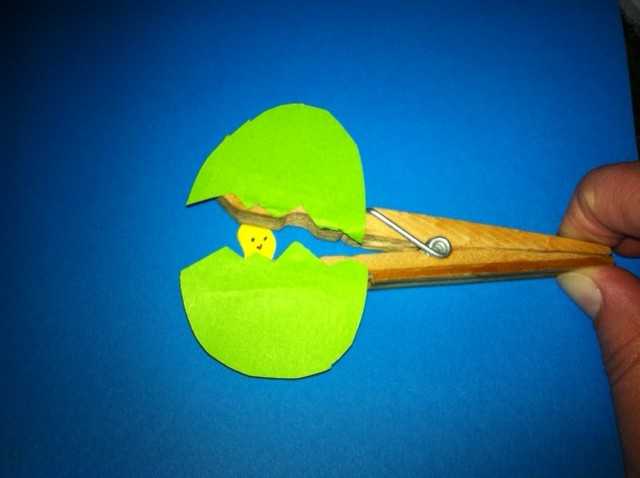
Peek-a-chick

8. Peekaboo chicks

How to : Cut a small egg shape out of card and then cut it in half horizontally (or if you’ve made collage cards just use your pre-cut egg shapes). Attach the two halves one side of a clothes peg, one at the top and one at the bottom. Draw a small chick and cut it out. Attach it to the other side of the clothes peg behind the egg top so when you pinch the peg together to the open it you’ll see the chick!

Focus on : Object permanence for babies and Knowledge of the World (eggs hatching)

9. Bunny whiskers mask

How to : Take some pipe cleaners and attach them to a lollipop stick (or two or three taped together for stability). Add a pompom for a nose and create some adorable bunny whiskers

Focus on : Role play – make bunny faces and hop like bunnies !

The wheels on the car go round and round

© Teo73 | Dreamstime Stock Photos & Stock Free Images

It’s a rare child who never has to go in the car, and an even rarer one who never fights going into the carseat or gets bored after 5 minutes making a journey less than pleasant for everyone involved. Today we’re going to look at some ideas which will hopefully make your life easier.

Earlier this year we came across a nifty little product on Twitter, called My Car Step, which attaches safely to the car seat. Invented by a mum fed up of battling her daughter, this award winning product allows children to climb into the carseat by themselves instead of being lifted, or manhandled, in. As we said in our post on tantrums, allowing children independence can defuse situations and, as a bonus this will save your back some strain, because you no longer need to perform contorted lifting manoeuvres. For nannies or childminders, who can lift multiple children into carseats on a daily basis for twenty years or more, good lifting technique and minimising strain is invaluable.

Once your little cherubs are safely attached it’s worth making the environment as comfortable as possible. Sunshades will reduce glare and making sure that the children are wearing the name number of layers as you will allow you to control the car’s temperature appropriately. Take their personal preferences into account regarding recline where possible – better that a child is happy but falls asleep upright than is reclined from the start and protests all the way. On long journeys you can stop briefly to adjust the recline to ensure they remain comfortable. Before setting off check that they have any toys within easy reach, and if necessary a drink of some kind.

Music can make journeys a lot more bearable for children, as singing along to their favourite nursery rhymes with sound effects and actions will keep them occupied. If it gets unbearable for you make a compilation of songs you all enjoy and listen to that instead. While you may appreciate the radio, young children may be bored by adverts and some songs won’t be age appropriate.

One perennial favourite is I-spy, a game with endless possibilities and several variations. Under-2s will join in looking for objects if you say ‘I spy with my little eye a bus/tractor/cow’. Preschoolers are able to identify objects associated with colours ‘I spy something red/green/yellow’ and once children are confidently recognising phonics or letters your can play the classic version.

Older children who don’t get car sick can play a version of I-spy bingo. Create some cars with pictures of different objects such as a bus, a set of traffic lights, a bicycle or a letterbox, and include some less common ones. When children see the object they can mark it on their card. The idea is to get a row, or if your feeling really adventurous, a full house. This also improves memory and recall as they will need to be able to tell you when and where they saw the objects.

Children who can recognise letters can help you make up funny sentences from the letters on car number plates. Y491 AMS makes You Are My Squishy or You Ate Many Satsumas. K920 LSC can become Katie Likes Scented Candles or Kicking Leaves Someone Crying.

Even young children can get involved in making up stories about other people on the road. This enhances social and emotional development, introduces children to situational humour, and exercises their imagination. This is especially good if you’re stuck in traffic and can see pedestrians walking by. You can pick someone who is walking by and ask the children where they think the person is going. Are they in a hurry? Why might that be?

Check our our ‘Travel with children‘ board on Pinterest for more ideas.

Finally, even if the traffic is frustrating, you’re late and it’s raining outside, keep your cool. Children will easily pick up on tension and frustration, and if you’re constantly enraged when on the road they’ll begin to associate going in the car with negative emotions. Ideally journeys should be fun and education, but most of all, happy!

We hope you find some of this helpful. What’s your fail safe technique for car journeys?

More Great Childcare II

In our first blog post on the changes proposed by Liz Truss we focused on the changes to ratios. This second part is about the changes which relate to qualifications. To understand this one must first understand that Professor Cathy Nutbrown undertook a review, culminating last year in the report Foundations for Quality which made a number of recommendations. More Great Childcare is, amongst other things, the Governments response to that.

Early Years Educators

Liz Truss proposes a new standard ‘Early Years Educator’ badge for qualifications. As anyone who has looked into gaining a qualification over the last decade, or looked at employing someone, there is a huge array of qualifications, some of which are simply a rebranded NNEB and some of which are barely worth the paper they’re written on. These were all slimmed down the the Diploma for the Children and Young People’s Workforce, which was criticised by Nutbrown’s review for being, amongst other things, too broad. Clarity here would probably be welcomed by everyone.

Early years teachers

More Great Childcare proposes a new status and training course for Early Years Teachers, a postgraduate qualification that will focus on teaching in the early years and have the same entry requirements (including the skills tests) as school teachers, but crucially stops shorts of giving Early Years Teachers the same Qualified Teacher Status that their primary and secondary colleagues have. Given that there is already Early Years Professional Status, which can be taken by professionals working in registered settings, the proposed change doesn’t seem to go much further and is likely to be a source of discontent.

GCSE Maths and English

Nutbrown recommended that all entrants onto an early years qualification hold a level 2, with the reasoning that learners should be ‘confident and capable in their literacy and numeracy’. The Government has interpreted this as a grade C in Maths and English GCSE.

This has been of particular interest to many on our Facebook page. It used to be a requirement of many colleges before entry, and some people seemed unaware that this policy had changed. Others appreciated the need for English to develop children’s communication skills but questioned the need for maths. Still others placed a higher value on aptitude for working with children.

Nannies in particular, who are not obliged to hold any qualifications, are uniquely affected by this recommendation. Parents can order their own priorities when hiring a nanny, but particularly for those with school aged children GCSEs and further educational qualifications are increasingly important. A quick random poll revealed that parents felt academic qualifications combined with a natural affinity for children actually outweighed the need for formal childcare training. What would Nutbrown or Liz Truss say to that?

So how does this link back to ratios?

Professor Nutbrown herself suggested that the Government explore whether qualified teachers could work with more three and four year olds. The Government re-examined ratios in a larger sense and suggested increased ratios possibly based upon:

–          Setting based criteria e.g. 70% of staff qualified to level 3; 100% of staff qualified to level 3; 100% of staff to have a C in Maths and English; at least one graduate plus 70% of staff qualified to level 3

–          Practitioner based criteria e.g. only staff with a C in English and Maths to operate the higher ratio

There is some sense in the second requirement, although we don’t recall our GCSE (or O-level) certificates giving us extra eyes or arms, in that the paperwork is going to increase by 50% and strong literacy and numeracy skills will be essential to cope with that in a timely manner.

What does this mean for people already working in early years?

If you already have a qualification rest assured, that will be assessed against the criteria in place when they were awarded. If you are working, or wish to work, in a nursery and you don’t meet the literacy and numeracy requirements you may find your prospects limited. If you don’t have a qualification you may find that you need to brush up on your maths or English first.

More Great Childcare

The biggest changes to childcare in a decade were announced early this week. A report, entitled More Great Childcare, was sent out by Elizabeth Truss MP, the Minister with responsibility for early years. Two major changes were proposed: relaxing the adult:child ratio for childminders and nurseries and setting out new plans for qualifications. This is the first of two blog posts on the report – first we’re going to look at ratios and the second post will be about qualifications.


What are the changes?

For nurseries the ratios will become 1 adult to 4 babies and 1 adult to 6 toddlers with no change to the ratios for pre-schoolers.

Childminders will still be allowed to care for 6 under 8 but routinely 4 under 5, of which 2 can be under 1 instead of 3 under 5, 1 under 1.

There is no change affecting ratios for nannies.


We spoke to Penny Webb, a childminder with 30 years’ experience who starteda petition against the changes. She currently uses the exception granted under EYFS2012 to regularly care for four or five under-5s on grounds of continuity of care.


I am shattered every day, I am doing more tasks in my own time that used to be able to fit into the working day. I am passionate about childminding – the children will always come first and will always experience outstanding care and education but I know that I can not maintain this level of commitment and this level of effort long term.” Penny Webb, Childminder


She also warns against the impact on children of childminders who rush into caring for too many children at once with little or no experience. Even as a mother of four and with many years of professional experience she has been surprised by how tiring her current workload is. 


“I do know people will do it for the money – I also think some will take on more children – with best intentions and then ‘crash and burn’. This will be bad for the children as either will stay with that minder and not have the best experiences – or the minder will be honest and the child will have to go to a different setting – very bad for emotional development.” Penny Webb, Childminder


That’s without even getting started on the lack of space in most homes for 4 under-5s, the difficulties finding triple prams, the cost of a seven-seater and car seats, and the sheer enormity of keeping 4 under-5s safe when out and about. The Minister also shows no sign of allowing OFSTED to slacken their regulatory role, intending to make them the sole authority over childcare settings (the role is currently shared with Local Authorities). This means the paperwork burden on childcarers who are obliged to follow EYFS will go up by 30% for childminders and 50%  for nursery staff.


Em, a former nursery worker who is now a nanny, highlighted that current arrangements already impacted to the interaction she was able to have with the children ‘to their disadvantage’. She feels becoming a nanny gave her freedom to really bond with children and follow their interests, and the care the children receive is better for that.


“That kind of ratio would seriously change my mind about nursery work [in the future] especially with the paperwork burden on nursery staff at the moment let alone with more children in their care. It’s insane!” Em, Nanny


Private nurseries in favour of the changes have been accused of only being interested in profit however Sarah Steel, MD of The Old Station nursery points out that any cost saving from relaxed ratios is likely to be eaten up by increasing quality, paying staff a higher wage and subsidising Early Years funding. The most worrying consequence she sees is a potential two-tier system.


“Those in most deprived areas, where nurseries are already struggling to survive, will have to embrace lower ratios, but this may be at the cost of quality.” Sarah Steel, MD, The Old Station Nursery


This is most evident in areas which are supposed to offer funded places for 2 year olds, an age group where the number of children per adult has been increased by 50% and where struggling nurseries may have no choice but to make ends meet by reducing staff costs. Even experts are unsure that more children per adult will lead to a reduction in cost. Eva Lloyd, from the University of East London, said there was no relationship between ratios and cost to parents. She is also sceptical that higher quality will be possible under the proposed changes and it’s easy to see why. The most highly qualified childcarer is physically limited in the number of children they can safely care for or comfort at once. Higher ratios may effectively prevent them from deploying their knowledge and reduce them to refereeing hordes of toddlers. The members of the PLA  seem inclined to agree and Laura Henry, an early years consultant but also parent of two boys, posted an impassioned letter on her blog aimed at parents.


Even though the changes proposed don’t mention nannies it would be naïve to assume they won’t somehow be affected. On the one hand it’s good news for the sector – parents who are unhappy about the quality of care offered by local childminders or nurseries may look into a nanny or nanny share. A nanny with 4 under 5 would still be able to dedicate more time to his/her charges because nannies are not required to provide reams of paperwork for OFSTED inspections. On the other hand parents may find it more difficult to find quality candidates. It doesn’t take a GCSE in maths to work out that reducing the required number of adults to care for a roomful of 12 toddlers from 3 to 2 leaves a member of staff without a job. The BAPN expressed concern that the nanny market may become flooded by nursery workers who have been made redundant because they are no longer perceived as fit to work in nursery settings, leaving an entire sector of the market lagging behind in terms of quality.


Many parents are unhappy about the changes. The online parenting forum Mumsnet revealed that only 5% of members surveyed polled in favour of relaxed ratios and Netmums reported a figure of 20% in favour. They may still be faced with an impossible choice, to pay over the average for a provider with low ratio and high quality care or accept lower quality care for lower cost. Parents who are unable to get spaces in settings offering coveted lower ratios may stretch themselves to pay for a nanny until the funded hours kick in at 3 years old, an age group unaffected by the ratio changes.