
Employed or self-employed?

This is a question which comes up a lot and there isn’t really a short answer. Employment status depends on each individual job. Being self-employed for one activity doesn’t mean that a nanny is self-employed for all jobs. Some nannies may find that they are employed part of the week by a family that they work for regularly and self-employed part of the week working with lots of different families. We’re going to look at some of the indicators of employment status that HMRC use to assess status and the pros and cons of being self-employed for nannies and parents.

  • Do they have to do the work themselves?
  • Can someone tell them at any time what to do, where to carry out the work or when and how to do it?
  • Can they work a set amount of hours?
  • Can someone move them from task to task?
  • Are they paid by the hour, week, or month?
  • Can they get overtime pay or bonus payment?

Nannies are usually:

–  required to look after the children personally

– required to follow the reasonable instructions of their employer, in a place determined by their employer and at a time chosen by their employer

–  contracted for a set amount of hours per day or per week

– able to have their job description changed by their employer

– paid hourly, weekly or monthly

–  paid extra for overtime and may receive a bonus


  • Can they hire someone to do the work or engage helpers at their own expense?
  • Do they risk their own money?
  • Do they provide the main items of equipment they need to do their job, not just the small tools that many employees provide for themselves?
  • Do they agree to do a job for a fixed price regardless of how long the job may take?
  • Can they decide what work to do, how and when to do the work and where to provide the services?
  • Do they regularly work for a number of different people?
  • Do they have to correct unsatisfactory work in their own time and at their own expense?

Nannies are not usually:

–  able to hire an assistant, unlike childminders

– required to risk their own money

– expected to provide the major pieces of equipment, such as a pushchair

– paid fixed price regardless of length, they are paid hourly, weekly or monthly and have fixed working hours

– able to decide the manner, timing and location of the work, the parents usually decide the hours required

– required to correct unsatisfactory work or finish tasks on their own time, they are typically paid overtime

The only criteria for self-employment a nanny may meet is working reguarly for a number of people.


So it’s clear that the majority of nannies working regularly with a family in a permanent position are employed. Even if a nanny works for 5 different families, each on a fixed day each week they are still likely to be employed by each of those families as employment is determined on a job by job basis.


Temporary nannies and specialists such as maternity nurses or behaviour consultants may meet certain additional critera. They may have risked their own money to undertake necessary specialsit training without a guarantee that they will be successful in finding work. They may decide the hours and days that they are available. They may agree to work for a fixed fee for an unspecified length of time.


Although self-employment can seem an attractive prospect it’s important to fully understand the implications for nannies and parents.


Pros for nannies:

You are in control of the times and days you work, so you can dictate when you will take time off and arrange to care for other children at the same time.

Some of your business expenses such as training and insurance can be offset against tax.


Cons for nannies:

You do not get sick, maternity or holiday pay.

You are not paid mileage.

You need to carry out a self-assessment each year for tax purposes, which means keeping accurate records.

You need to invoice parents for the work carried out.

You do not have a secure income.


Pros for parents:

You pay-as-you-go and are not liable for holiday, sick or maternity pay.

You don’t pay mileage – a self-employed person charges an all-inclusive rate which covers their expenses.


Cons for parents:

The overall cost is likely to exceed the gross wage agreed with an employee, as self-employed nannies need to put money on the side to pay their tax and national insurance and to cover periods without work.

If HMRC decide you should have been employing your nanny you will need to backpay the tax and National Insurance plus a fine which can be equal to that amount.

Your nanny can decide they are not available to work, leaving you without childcare.

Your nanny can make arrangements to substitute someone else in her place.

Your nanny is not obliged to provide exclusive care for your children as long as she does not exceed two families at any one time.

You don’t have the same level of control over your children’s day.


Calculating holiday entitlement

Standard holiday entitlement in the UK is 5.6 weeks, which include all Bank Holiday, pro rata for part time workers. But what does this mean? When does it start? What if you work part time or varying days or reduced hours for part of the year or term time only?


If you work full time you will get 4 weeks holiday and the 8 ordinary Bank Holidays (New Year’s Day or the following Monday, Good Friday, Easter Monday, the early May Bank Holiday, the Spring Bank Holiday, the August Bank Holiday, Christmas Day or the following Monday and Boxing Day or the following Monday or Tuesday). This give you a total of 28 days holiday.

To calculate your holiday entitlement for part time work, where you work the same days and hours each week you simply divide those 28 days by 5 to get a figure for 1 day per week and multiply by the number of days you work – so for 3 days it would be (28 days / 5 x 3 days)

1 day = 5.6 days or 1.12 weeks

2 days = 11.2 days or 2.24 weeks

3 days = 16.8 or 3.36 weeks

4 days = 22.4 or 4.48 weeks

Holdiay can be rounded up, but not down.


If you work term time only then you can use a similar calculation substituting weeks for days. In this example we’ll assume that there are 39 school weeks, so you get 4.2 weeks holiday (5.6 weeks / 52 x 39 weeks). If you have to take your holiday outside of term time then you may have an arrangement that you are paid in lieu of holiday. Alternatively you may be employed for 44 weeks of the year to allow for the holiday to be taken during your period of employment.


If you work different hours on different days but still work a fixed number of days per week you may find it more useful to calculate your holiday in terms of hours. For example Monday and Tuesday are 10 hour days but Wednesday, Thursday and Friday are 5 hour days. Taking 5 Mondays off would give double the amount of time not worked but still use the same amount of holiday. To calculate holiday in hours just add up the number of hours over a week, in this case 35, and multiply that by the number of weeks holiday entitlement, in this case 5.6, giving 196 hours (35 x 5.6).


The same principle applies if you work part-time in term time and full time in school holidays. In this case you need to calculate the number of hours worked over a year, for example 4 hours per day, 5 days per week for 39 weeks per year ( 4 x 5 x 39,) which is 780 hours, and 10 hours per day, 5 days per week for 13 weeks per year (10 x 5 x 13), which is 650 hours, giving a total of 1430 hours per year. This is then divided ny 52 to get the average weekly hours (1430 / 52) which is 27.5 hours and mulitplied by the weekly allowance for a full week, 5.6, to give 154 hours holiday a year. That means 15.4 days if taken in school holidays or 38.5 days if taken in term time – quite a difference!


If  you work varying hours and can’ establish a weekly average then it may be best to calculate holiday using the accrual method, so for every hour you work you earn 12.07% of an hour as holiday.


Holiday is distributed according to a leave year. This is usually specified in the contract, and many run from 1st January to 31st December, with a pro rata allowance for the first and final years. That means if you leave a job after working 10 weeks you will get 1.1 weeks holiday (5.6 weeks / 52 x 10 weeks).


We hope this helps you to make sense of your holiday entitlement, and remember you can always post on our messageboards to  get advice from other nannies specific to you.


The Pufflympics

Stuck for ideas? Why not try a themed activity week?! Nanny Claire has done weeks of activities centered around Princesses,  cars and space, and here she shares her Winter Olympic theme with a twist.


I’m a nanny and look after 3 children, two girls E 12 years old and AM 6 years old and one boy AC 9 years old. My job is usually part-time, I do the school run and then ferrying around various after school activities and playdates. However, there are times that those who look after children dread…the school holidays.

I had not given much thought as to what we were going to do all week, swimming, movies and playdates were confirmed but they don’t take up the whole week. On Monday the kids were having breakfast and it just so happened that the Winter Olympics were on, so especially with sports obsessed AC, we  were watching the curling. I’m usually quite strict on TV hours, switched off after breakfast until at least 4:30pm, but the Winter Olympics is not on every  week so it’s an exception to the rule.

As most of us who look after children know, it’s not long before we get the inevitable phrase “What are we going to do today?”, one of the kids said that curling looking fun so I said I bet we can find something to do curling with if you get washed and dressed, at which point they vanished like speedy ninjas.

So now I had to find something to play curling with, I wandered around looking at the various toys and then I saw the puffles…If anyone doesn’t know what a puffle is, they are pets for penguins on the popular Club Penguin game, they are basically small round, come in various colours and have fuzzy hair. There happen to be quite a few in the kids collection, kind of curling stone shaped and should slide across the floor quite nicely!

The weather outside was typically pouring down with rain, so I tested some chalk on the kitchen tiles just to make sure it would come off  later (not my floor after all!), no problem there so I sketched out some circles to represent the house in curling, got the brush out of the cupboard  and we were ready to go! There was soon puffles flying in all directions and much laughing, arguing and cheering. We decided that scoring would be whoever got their puffles closest to the middle on their turn, I didn’t expect the game to be such a big hit and the kids asked what other events we could do.

So we looked up the other Olympic sports there were, and I tried to work out how we could replicate them at home, a brief thought of kids  sliding down the stairs on trays entered my mind swiftly followed by thoughts of a trip to A & E. However bob sleigh could work, if we made them for the  puffles and not the kids. So at dinner I told the kids we were going to be making bob sleds for the puffles tomorrow.
On Tuesday morning I was greeted with much excitement, “Are we still making sleds for puffles today? After breakfast I raided my box collection, always have a variety of empty boxes for such rainy days, I cut down 3 boxes to the same size for each of them, out came the glue, and various arts and crafts paraphernalia. There was much discussion about what would make it slide better, runners on the bottom, aerodynamics, making it look pretty, etc.


I fashioned a slide out of some cardboard box strips and white bin liners, and put it on the stairs, we then timed each puffle and recorded the time. The kids spontaneously decided to create a team name and made-up country for their puffles, so we then had team Fermat for E, team Mouseling for AM and team I Don’t Know for AC, they created maps for their countries and an event chart went up on the wall, all their own ideas I’m proud to say.


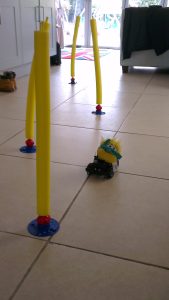
The pressure was now on me to come up with the next day’s event, thinking of the events involved I decided that the Ski slalom was possible with a little help from a remote control car! This did involve tying the puffle to the car under the pretence of a seat belt, and the kids made crash helmets out of craft foam for them! The kids have a building set called Cranium which is a set of poles and cloths which can be constructed to create play houses, etc. and the poles turned out to be quite useful for slalom flags. We opted for the rule of having to go around 2 poles at least and not all of them, this way they all had a good chance to get around the course successfully. They had plenty of time to practice driving the car before we did individual times and recorded them on the event sheet, needless to say puffles and poles went flying in all directions!

I went home that night and dreamt of puffles, and how to do the next event! I decided that I could recycle the bob sled run into a ski jump  and use the remote control car again; we used a sun lounger cushion so we didn’t mangle the car. I admit the car was very slow but managed to construct  the jump so if you lined up well you could get the car to do a small jump off the end, sufficient enough to get a small measurement anyway. The kids all got  to practice again before we took some final measurements. This wrapped up the final event of the Pufflympics, the next day was Friday and the last day of the holidays.

We decided to host our own closing ceremony; a toy shopping trolley became a puffle parade float with a few adaptions of course. The kids designed their own part of the float to put their puffle on to reflect their team and country. Next was designing their own podium step, E helped me make some medals by gluing some sequins to stickers and then cutting them out. E made a party playlist on her iPod and wrote a speech, AC lined the parade route on the floor with string and AM helped me get some food ready. It was junk food heaven as I let them have full reign on what food they wanted, so we had hot dogs, pizza, chips, cheese sandwiches and squishy tomatoes (AM really really likes cherry tomatoes roasted until extremely squishy)!

So after a busy week hosting the Pufflympics the kids had been entertained all week when it was generally too rainy to go outside, and I hadn’t been driven mad by kids asking what they can do every 10 minutes. Most importantly we all learned a lot more about the winter Olympic sports, lots of fancy new words and rules and at a fraction of a cost compared to the real thing. I essentially used toys and things we had in the house, the kids had a blast and spontaneously  added lots of their own ideas of what they could do. If you fancy hosting your own event you don’t necessarily have to have puffles on hand, cars would also have made great competitors for the Carlympics or a variety of cuddly toys for the Cuddlympics? You don’t need to be confined indoors or to the Olympics either. Why not host the World Cup or the Commonwealth Games outside?

The Trouble with Teens

The trouble with teens is they think they don’t need a nanny or au pair, especially if you’ve been with them since they were much younger. They might feel that they’ve outgrown you or be embarrassed that their friends don’t have someone looking after them. The truth is they don’t need you in the same way but that’s not to say they don’t need you at all.

They need a cook, chauffeur, laundry maid and friend – all of which are file in the dictionary of job descriptions under ‘nanny’. Parents who keep nannies on for older children often have busy lives, working long hours or traveling frequently and want someone else to take care of the day to day tasks so weekend time as a family can be maximized. So teens do still need someone to buy their supplies for school projects, someone to make sure they get some dinner and someone they trust who isn’t a parent or teacher to talk to. Next time they say they don’t need you then point out all the practical things you do.

The teenage years are a difficult time bringing lots of changes. If you’re young you might find it difficult to maintain your authority because they realise that firstly people have to earn respect and authority and secondly they’re not so much younger than you after all, which is often a problem for au pairs. If you’re more mature they might feel that you’re out of touch and don’t understand them.

Take time to connect with teens in your care. Fake an interest in the latest band/singer/soap if you have to because it’s important to them and it gives you something safe to talk about. Give them space and privacy with their friends and don’t push them for details of what’s going on at school unless there’s a problem.

Give them freedom, as long as your employers are happy, to manage their time or walk back from school/the bus by themselves. Learning independence is an important part of being a teen and it can be hard to resist the temptation as a nanny to ‘nanny’ them. Sometimes the very title nanny is a red flag to teens so have a chat with them and come up with a description you’re both happy with that they can use to other people. You can become their sibling’s nanny or a family assistant – your professional pride might take a hit but you can still list the job as nanny on your CV.

The hardest thing about nannying teens is leaning that you have to give a little on the boundaries. Consistency and structure are vital for toddler and younger school aged children but teens needs negotiation too. Get it right and you’ll have a treasured place in your teen charge’s heart, not that they’ll ever admit it!

First Aid for childcarers

One of the most common requirements for childcarers is a valid paediatric first aid certificate. All registered child minders have to hold this, as well as OFSTED registered nannies. Nurseries only have to have one member of staff trained but it’s good practice for most, if not all, staff to have done a course.

Accidents can happen at any time and frighteningly quickly. One of the biggest risks for small children is choking. The leading First Aid organizations in the UK have just published new guidance for managing choking in a baby. Instead of lying the baby along your arm and giving back slaps to dislodge the blockage they now recommend putting the child face down across your lap to administer back slaps. Changes like this are part of the reason a First Aid certificate should always be within date and fully renewed every 3 years.

It’s important to make sure the certificate specifically covers paediatric first aid as some treatment is different for children that won’t have been covered on an adult course.

Thorough First Aid training means a childcarer should feel confident about handling an incident and this will help them stay calm and remember what to do. A course should also involve hands on practice to ensure the techniques are correctly understood. No amount of reading can replace this practical component.

We urge parents to ensure their nannies and babysitters are trained in First Aid and support this petition to make it a legal requirement for all nursery worker to hold a First Aid certificate too. Please take a moment to read and sign.

First Aid courses are available through organisations such as the Red Cross and St John’s Ambulance, private providers and many nanny agencies.

Emergency planning

If you’re in the UK right now you won’t have been able to escape the weather forescats and the news reports of severe flooding, high winds and power outages, but how many nannies have an emergency plan agreed with the parents in case of disaster?


Imagine this:
Your workplace is on a flood plain and you start to notice water coming up through the drains. The river has flooded nearby fields and the road outside has started to flood. You start to worry that if you stay put you won’t be able to get your car out and will be trapped by the water. What do you do?

Or maybe you’ve been out for the day and as you return to your bosses’s house you find that the road is so flooded you can’t get by. Where do you go?

Obviously remaining in your charge’s home, where you employers expect you to be isn’t an option in either of those scenarios, but in the thick of an emergency situation it may be difficult to keep parents informed every step of the way. This is why a pre-agreed emergency plan that both nanny and parents are aware of is so important. Even if you don’t live on a flood plain you never know what might happen!


1. Agree a safe place, or two safe places in case one is also affected
If parents return home to find you gone and can’t get in touch with you they will know where to look. This might be your own home, your charge’s grandparents or a nanny friend’s. The idea is that you have somewhere to go away from the disaster, so the next street over probably won’t cut it. Make sure you know several alternative routes to get there too, and take natural obstacles like rivers into account.
 

2. Make a list of what to take with you

When you evacuate a house you need to assume that you won’t be back for a while. Some things, like a change of clothes and any special cuddly toys, you’ll take automatically, but your employer might want you to also take important documents with you too. Ask them if they have a file they would like you to grab on the way out, and if they don’t suggest they put one together.


3. Know how to secure the house before you leave

Obviously you and your charges are a priority but knowing how to switch the gas/electricity/water off (especially if it’s a gas leak or a plumbing disaster) could save time later.


4. Set an emergency contact

If you can’t check in with your employers for some reason, or they can’t reach you, designate a third party contact. That way if you have to leave your charge’s house and go to your agreed safe place you can leave a message with your employers and another person.


5. Have a waterproof emergency kit

Nannies nowadays usually have contact numbers on their mobile phone, and that’s fine until the network gets overloaded or your phone slips out of your pocket into the rising floodwaters. First item in your waterproof kit is laminated contact details for the parents and emergency contact. You should also laminate all your emergency information: your safe place, your ‘to-take’ list and instructions on how to secure the house. You should also have food and water, including baby milk if necessary (you can buy pre-sterilised, pre-made bottles), a first aid kit, and a torch and batteries.


It might seem extreme, and we hope you’ll never need to use it, but when it comes to you and your charge’s safety better safe than sorry!

Attachment childcare

Most people have heard of attachment parenting, if only in sensationalised form, also known as the Sears method. The idea is that an infant is kept as close its mother, or other caregiver, as possible by breastfeeding, using a sling, bed-sharing, responding sensitively to cries and, as the child grows, ensuring that any separation is child led as far as possible. It must be said that many parents follow some of these principles without defining themselves as attachment parents but when parents openly say they follow attachment parenting some childcarers start to panic.


There is no need to worry. Although the label might sound off-putting, by entering into a dialogue with parents about how they practice attachment parenting will help you understand and accommodate their child’s needs.


1. Breastfeeding

This is obviously a logistical problem when any breastfeeding mother goes back to work. Make sure you and your setting are supportive of continued breastfeeding; know the value of expressed breast milk and how to handle it, talk to the mother about feeding times and whether she would prefer you to feed the baby just before collection or her to feed on arrival/at home to fit in with her pumping schedule, and try attachment bottle feeding.


2. Using a sling

If a baby is accustomed to being held and soothed by their caregiver it’s very important to continue this in some way during the transition to childcare and the easiest way to do this is to use a sling. Slings are a very individual decision but try asking the parents for their input if you don’t have one of your own that fits you comfortably.


3. Bed-sharing

This is often the trickiest adjustment. It isn’t advised for anyone but breastfeeding mothers to bedshare with their infants so as a childcarer, potentially caring for other children at the same time, it’s not practical. Make the sleeping area as familiar as possible. Consider asking the parents to provide a pillowcase and blanket that they have slept with to provide a familiar smell and commit to stroking or patting the  baby to replace the comforting contact of their mother’s body or suggest naps in the sling. Above all don’t judge the parents for continuing to bedshare at home – it’s valuable time for them to reconnect and may allow the mother to rest while breastfeeding a baby who refuses milk during the day.


4. Responding to cries

One of the key principles of attachment parenting is a belief that cries are genuine attempts to communicate and should not be ignored. As any attachment parent of two or more will tell you this doesn’t mean running at the first whimper if you have another child to attend to, but
it does mean responding and trying to figure out what is wrong rather than leaving a baby to cry it out, or seeing whether he will settle after a few minutes crying by himself.


5. Child-led separation

Attachment parents may request a longer settling in period to gradually accustom their child to you and your setting. Use this time to observe and learn how the parents and child interact so you can provide consistency. It doesn’t mean that they don’t trust you or are hanging around to be difficult!

Smart socialising for nannies

One of the biggest concerns for nannies and parents alike is that nannying can be isolating for both nanny and child. Social contact is important for all human beings and as well as giving children the opportunity to play with others, going to groups and setting up playdates also gives nannies the opportunity to model social skills and how to form healthy relationships. But if you’re new to having a nanny or new to an area, how do you get started?

 

Have clear expectations

Whether you’re a parent or a nanny the interview process is the time to test out the other party’s take on socialising. It’s a question that might throw first-time employers but it can be helpful to remember that nannies don’t have coworkers and benefit from some kind of adult contact during the day so although it might feel like they’re asking to have their friends over to drink your coffee that’s not really the case, they just happen to have a network of ‘colleagues’ that they can take from job to job. There are no hard and fast rules , the most important thing is that both sides are happy with what is agreed.


Nannies don’t just have to see nannies

Sometimes new nannies can get hung up on only soicalising with other nannies and miss out on all the other social possibilities out there. While it can be great to meet up with someone who understands where you’re coming from, parents and childminders at groups with similar aged children can also enrich your social circle and at the end of the day playdates should be for children.


Be pro-active

Although there is a lot to get to grips with when you start a new job, be pro-active about finding social opportunities. Posting on the Nannyjob Meet Other Nannies messageboard or joining our social club for nannies can help you find nannies working near you and the Places to Go section will help you find activities in your area. Searching for groups and


Different social circles or friends in common?

This is probably one of the trickiest social situations to navigate. Are you happy to meet up with your boss’s NCT group and are they comfortable with that? Would you prefer that your nanny only meets up with people you know during work hours? What about playdates for school aged children? What about nannies who only work part-time? Again there are no hard and fast rules but communication is key to finding something that works for both of you!

Christmas presents for childcarers

Want to show your childcarer(s) how much you appreciate them but stuck for ideas? About to nip to Tesco to stock up on tins of Roses or bottles of vino? Hold on just a second and read our handy guide to buying something special for those other special people in your child’s life.

The task of buying for nursery staff can be daunting. Most parents opt for a a special something for their child’s keyworker and a joint gift for the staff in the room – a hamper with teas, herbal teas and coffees or some nice handwash and hand cream. They’re probably overflowing with chocolates and wine so think outside the box a little. Individual pamper hampers are a nice personal gift if you don’t have too many people to buy for or  individual cards with a voucher or gift card for an appropriate store will be appreciated too.

‘I didn’t know what to get the staff at nursery so I bought a plant for the staffroom and decorated it with cards and an ornament for each of them to take home’.


You’ll probably know a childminder or nanny better and be able to find something to their taste – a good book, tickets to a show or a gadget you know they’ll love. Unless you know that they love a particular type of chocolate or are partial to a nice G&T of an evening, try to avoid chocolate or alcohol based gifts. Equally a photo of your children, while very sweet, is unlikely to make them light up. They love them very much but chances are they have plenty of photos already. Cash always goes down well but it can feel awkward trying to decide an amount if it’s their only present- 1 week’s salary is a good guide for a nanny.

‘I gave my nanny a KitchenAid , which was less than a week’s salary but far more appreciated, and  a lift home so she didn’t need to take it on the tube!’


It can be more difficult giving cash to childminders, and if you’re strapped for cash a week is a lot of money, but if you do then make it clear it’s for them to spend on themselves. Sometimes the best gifts combine the practical with the personal – a case for an iPad or a smart hat and gloves set if you notice theirs are looking a big tatty. A token gift that you’ve put a lot of thought into is worth far more than an envelope stuffed with banknotes.

‘Our childminder is a big tea drinker but I know she restricts her cuppas to when my active 2 year old can’t charge into her and knock them over. I got her a spill proof insulated mug which came in handy when he dropped his nap.’


For a casual babysitter an extra bit of cash is probably most appreciated, tucked inside a nice card. If you prefer to give a present rather than slip an extra tenner their way then think about their interests or what they’ll find useful- if they’re a student then funky notebooks or pens for use in lectures may brighten up their day.

‘My babysitter is a retired lady who lives a few doors down and has a beautiful garden. We got her a new pair of gardening gloves and some handcream so she can keep up the good work.’


If a carer has their own children with them at work you might want to buy a token gift for them as well. This doesn’t need to be expensive but will be very well received by the children and the thought and effort will be appreciated by your carer too.

Whether you give a significant gift or not,  put the effort into making a card with your children – the glitterier and messier the better – and send a card from yourself as well with a note saying how much you appreciate them! That’s a gift that keeps on giving.

The nanny diary: Day 5

This post brings us to the end of our series following a nanny and a mother through the first week of a new job. If you missed the first posts you can find them here: Day 1, Day 2, Day 3, Day 4. And if you’re interested in writing a guest post or a nanny diary of your own then get in touch!

Nanny:

I felt really nervous all day with the chat looming in the evening.

I had questions of my own:

Do you still want me as your nanny?

Is there anything I did this week you would prefer I did differently? Is there anything I didn’t do?

I’m glad to say they still want me! And no major changes to be made! Which is a huge weight off my mind because nannying is such a personal job that when it doesn’t work out you feel like someone has broken up with you. Three more weeks of the probationary period to go still but a good start. It turns out it wasn’t anything bad at all, she just wanted time to think about real solutions to the stuff I’d raised throughout the week and I get the feeling that’s more her style than giving a quick yes or no answer, which I’m glad I discovered now before I need to ask something really important. Plus we’re probably getting a double pushchair and I’ve got a budget and free reign to choose two to show MB which I think is a really good sign, because if they didn’t want me to stay they wouldn’t be prepared to spend money on something they don’t really want, right?

Overall today was better than yesterday. No tantrums at least and I was super-efficient at getting all the jobs done.  I’m speeding up on the school run and probably getting fitter as a result and learning just how much leeway there is in the routine. It’s amazing how fast things become second nature, although I still need to check the schedule every morning before we start to make sure both boys have what they need for the morning even if I’ve put it ready the evening before.

I checked the calendar for the next month as well to give myself a heads up on anything important and it’s charge number 3’s birthday in two weeks, which brings a whole new load of challenges, not least how her siblings are going to be able to make her a card without her finding out! I’m really enjoying having such a busy job again. It’s a totally different kind of challenge.

Mother:

It’s Friday! And I don’t have piles of laundry! And the bedrooms are clean and tidy! I’m never letting this woman leave. That’s all!